Why Tas Skoudros’s Focus on Customer Problems Matters for Video Planning
Tas Skoudros, founder and managing director of StackTrack, discussed adapting to technological disruption in his Authority Magazine interview. His account covered a technical roadmap disconnected from customer growth, an expansion into AI-related work, and the difference between producing more work and producing something useful.
For businesses planning video marketing, the relevant connection is how production decisions get made. A new tool or ambitious content schedule can absorb attention before anyone has identified the communication problem. Skoudros’s observations offer a useful basis for deciding what deserves to be produced, how teams should coordinate, and when further investment is justified.
Give the Video a Business Problem to Address
Skoudros recalled supporting an early-stage fintech business with cloud infrastructure and development tools. The technical projects appeared sensible, but customer traction fell short of expectations. He described having a roadmap for scale without the scale, and said the team had not asked often enough how the business was attracting customers or learning what would make them stay.
He said StackTrack now connects platform work more closely to what customers want to achieve over roughly one, three, and six months. Its technical responsibilities were not independent of the business conditions surrounding them. Preparing infrastructure for growth needed a clearer understanding of how that growth was supposed to happen.
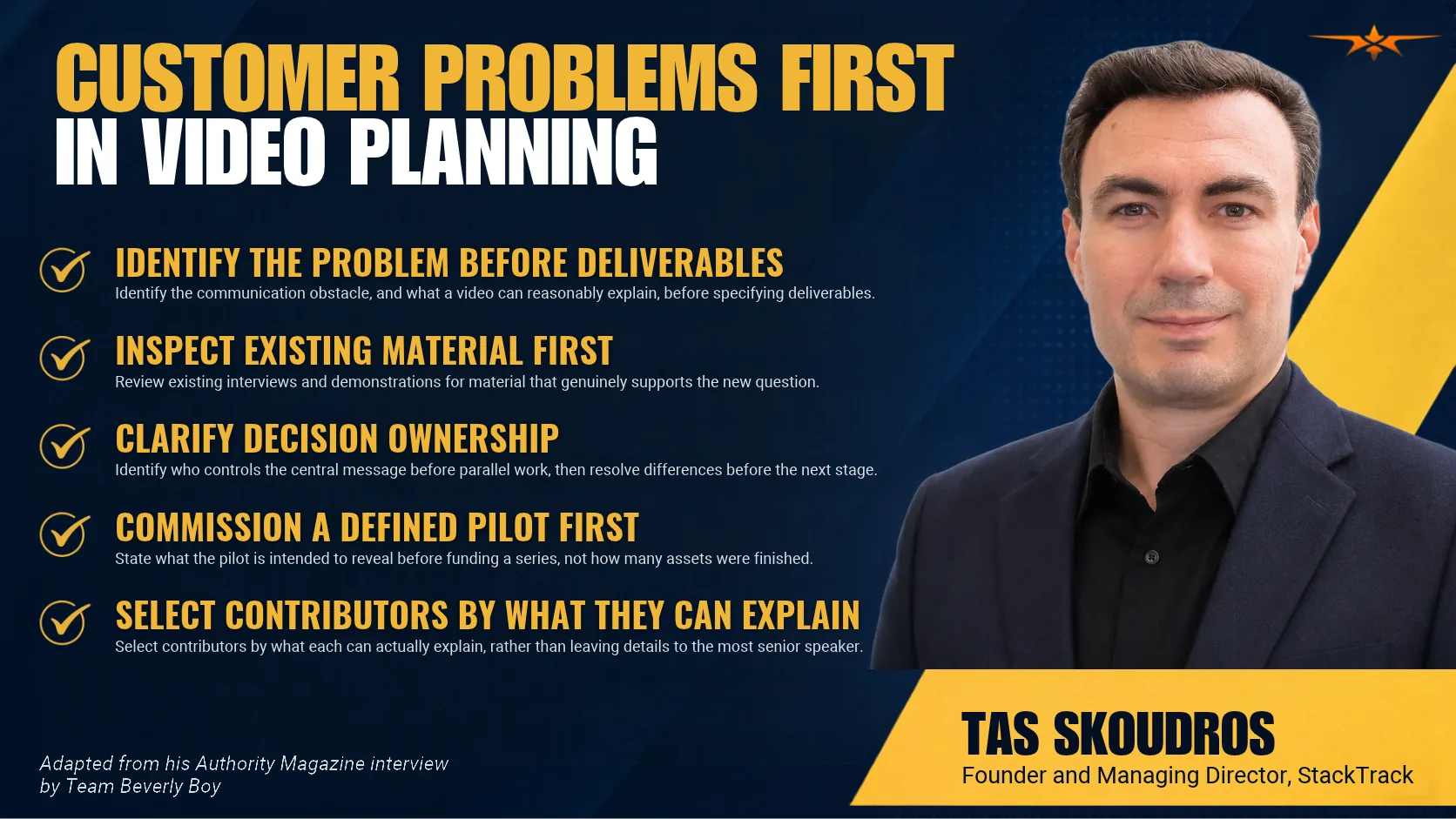
A related lesson for video planning is to identify the communication obstacle before specifying deliverables. A producer should establish what prospective customers currently struggle to understand and which part a video can reasonably explain. That answer should guide the treatment and script before the team commits to a series, animation package, or extensive filming schedule.
Look for Useful Extensions of Existing Material
StackTrack’s move toward AI-related services drew on capabilities it already had. Skoudros described growth in Runner services, the computing environments that perform automated software jobs. Scheduling temporary workloads, isolating them, and expanding capacity were familiar problems that could, with adaptation, support some AI workloads.
A hackathon broadened his thinking beyond the computing resources underneath those workloads. Working with systems that coordinate AI agents made him consider another engineering problem to which existing capabilities might apply. He described extending something understood into a related area rather than reinventing the company.
For a business considering a new video subject, the production application is to inspect relevant existing material before commissioning an entirely separate shoot. An editor can review interviews and demonstrations for material that genuinely supports the new question. Reuse should depend on what the footage establishes; a change in narration cannot make an old demonstration prove a new capability.
Faster Production Requires Shared Decisions
Skoudros observed that AI can make individual developers faster while making teams harder to coordinate. An idea can become a prototype before colleagues understand which decisions have been made. He connected that speed to a greater need for product judgment and shared understanding, rather than simply counting features produced.
He also described how serverless technology at Waitrose allowed developers to establish resources and deploy software with less intervention. His broader point was that a technology change can warrant changes in responsibilities and approvals. Retaining every previous process may prevent a business from benefiting.
For video teams using AI-assisted tools, a concrete response is to clarify decision ownership before parallel work begins. A producer should identify who controls the central message and when a change requires the script, visuals, and narration to be reconciled. Generating several versions quickly is less useful when each version expresses a different understanding of the offer. Approval should resolve those differences before the next production stage.
Make a Test Large Enough to Inform the Next Commission
Skoudros’s principle of making bets rather than defending beliefs provides another useful distinction. He advocated investing enough to learn whether an opportunity is real, then increasing commitment or changing course as evidence develops. He also warned that money already spent and senior endorsement can make reconsideration difficult.
His advice included deciding what results would justify further investment before committing heavily. That is narrower than waiting for certainty. It means making an initial decision that remains open to challenge, including after an influential person has supported it.
Applied to video marketing, this supports commissioning a defined pilot before funding a recurring series. The brief should state what the pilot is intended to reveal and what evidence would support another commission. If the purpose is to explain a difficult service, review should examine whether intended viewers understand that explanation, rather than treating the number of finished assets as sufficient evidence.
Use Different Perspectives to Choose Interview Subjects
Skoudros said StackTrack’s direction reflected several observations together: fewer routine support enquiries, interest in standardised platforms, continued Runner growth, and requirements arising from its own AI workloads. He cautioned against expecting one report or conversation to reveal an entire opportunity. He also said leaders should hear observations from people close to different parts of the work.
For an interview-led business video, that suggests a specific pre-production choice: select contributors according to what each can actually explain. A producer can speak with customer-facing staff and technical specialists before finalising the interview roster. Those conversations can reveal where the planned story needs another perspective, rather than leaving the most senior speaker responsible for explaining details outside their direct knowledge.
Team Beverly Boy’s Takeaway
We think editors have a particular responsibility when a business describes work that is still developing: preserve the speaker’s qualification. Skoudros distinguished encouraging technical results and signs of demand from a commercially proven direction. A promotional edit should respect that difference.
We would review any shortened soundbite against the complete answer before approving the cut. If removing a sentence turns a promising development into an established result, we would retain the qualification or choose another excerpt. We see that as a production judgment about the meaning of the finished statement, not merely its pace.
A finished business video becomes a public account of what the company knows and can support. Its usefulness depends partly on whether that account remains accurate after the production team has compressed a longer conversation.
This article is based on an interview originally published by Authority Magazine. Read the full interview here.