What Alisha D. Brown’s Visibility Strategy Teaches Video Teams About Introducing Founders
Alisha D. Brown, CEO of AD Brown Consults and an Employee Relations Consultant, spoke with Authority Magazine about the difficulties of building her business. The conversation covered a failed product launch, uncertainty about whom to serve, and her decision to become more visible as the person behind her company.
For businesses making founder videos, the interview offers a useful distinction between displaying a business identity and explaining who does the work. Brown’s account also gives production teams specific questions to address before recording: who needs this message, what expertise should it demonstrate, and how will the finished video reach those people?
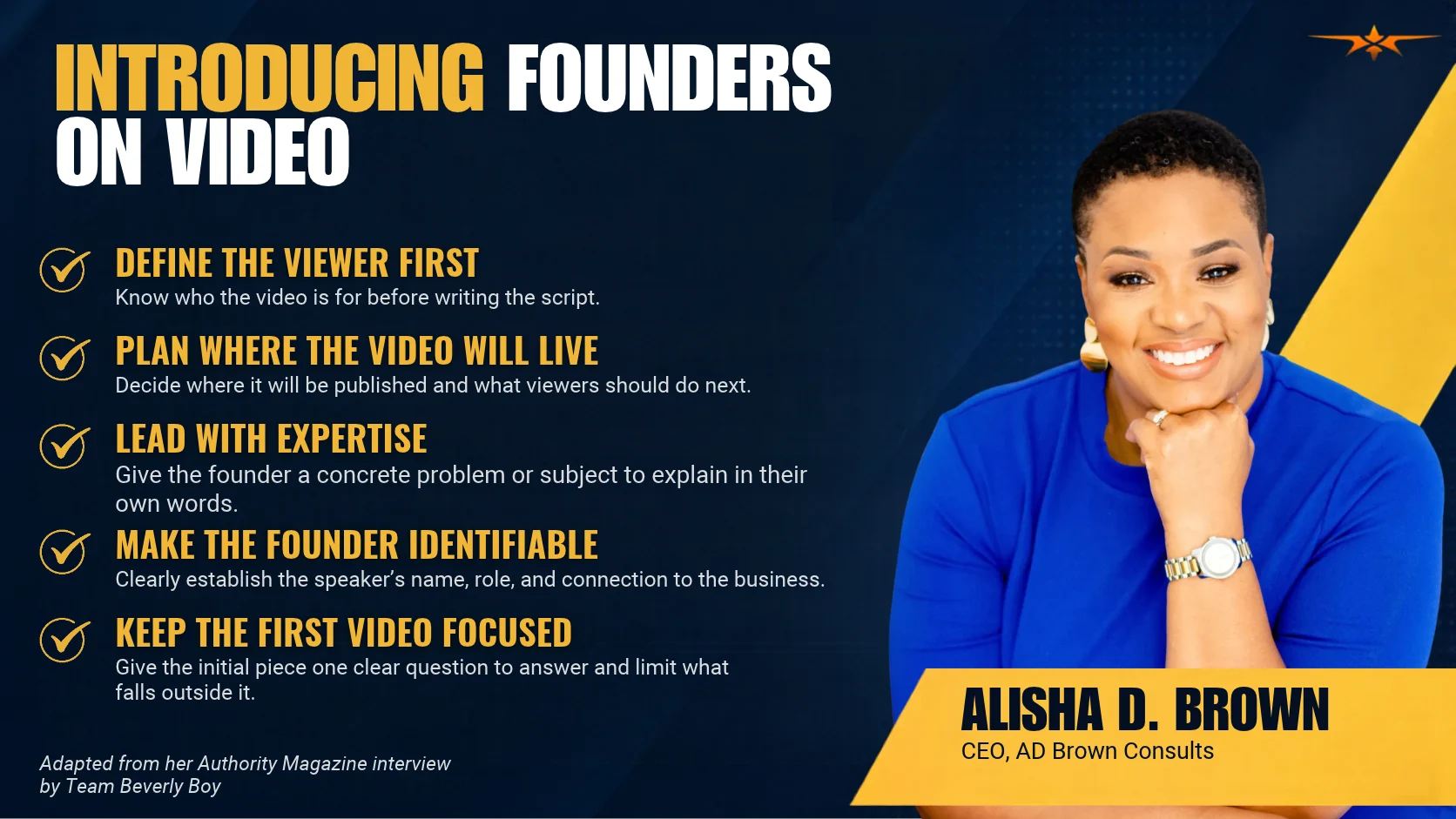
Define the Viewer Before Writing the Script
Brown described the end of her federal contract as a W-2 employee in August 2025 as a difficult transition into full-time entrepreneurship. She struggled to identify her audience and services. Although she wanted veterans to succeed, she identified first-time supervisors as the audience she resonated with best for employee relations consulting. She used about 22 large wall sticky notes to work through the audience question, then about 25 more to narrow her services.
That distinction matters when a founder has more knowledge than one video can reasonably contain. A producer should establish the intended viewer before drafting interview questions.
Treat Publication as Part of the Production Assignment
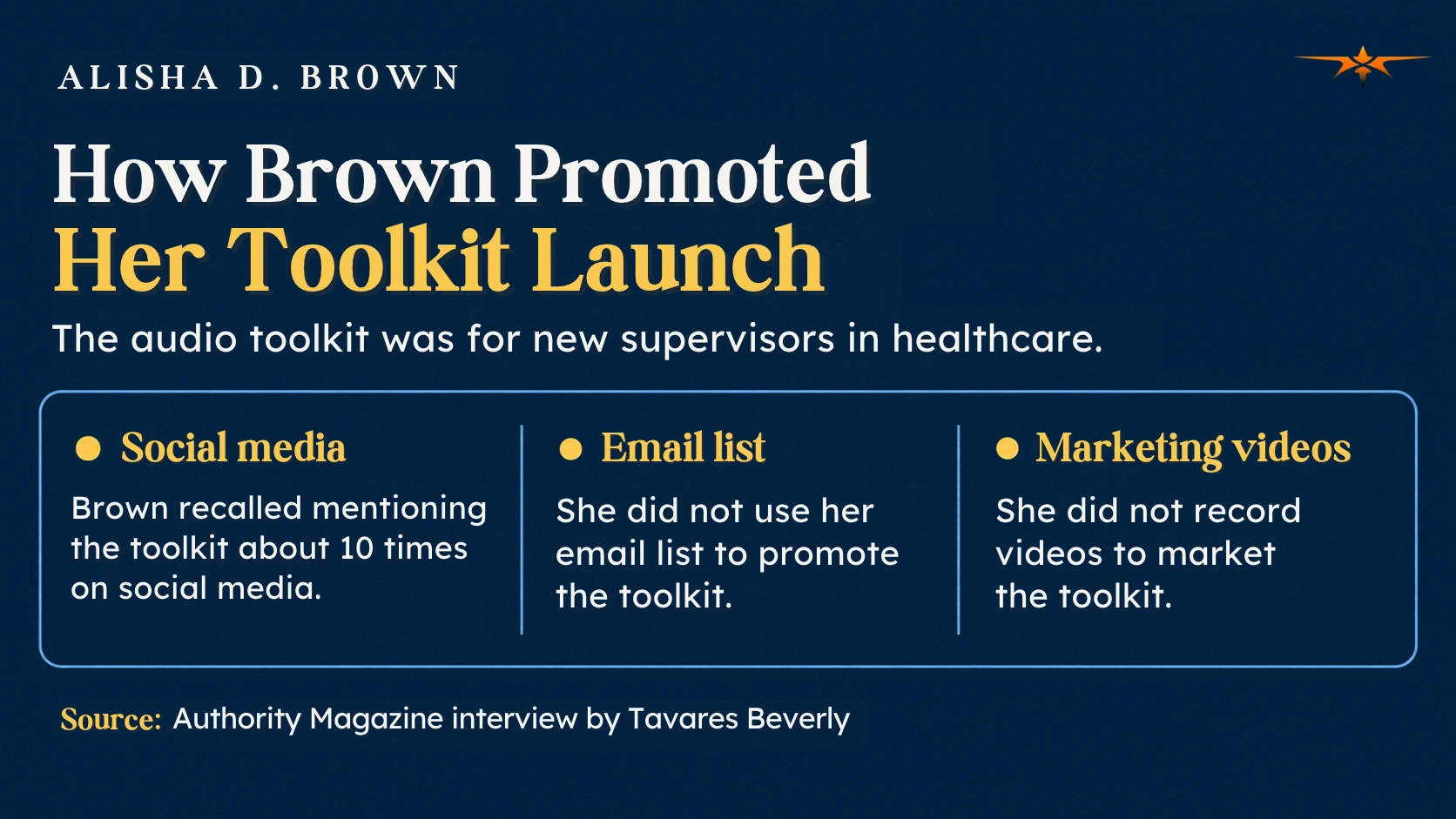
Brown took responsibility for a failed launch of an audio toolkit for new supervisors in healthcare. She said she had discussed it perhaps 10 times on social media, had not used her email list, and had not recorded marketing videos. Separately, she explained that her goal of helping 100 supervisors would have produced an expected $10,000 profit to fund a downloadable training suite. That projection was not met, and she missed a discounted offer on the training platform she wanted.
Her account supports a practical production question: where is the finished video actually going? Before filming a launch asset, the business should identify its intended publication location and the action viewers can take there. That information should shape the closing lines and any accompanying graphics. Brown’s account does not establish that video would have rescued the launch; it shows why producing promotional material and arranging its use deserve attention alongside developing the product.
Let Expertise Give the Speaker Something Concrete to Say
Brown recalled feeling discouraged when applications for speaking opportunities were denied. She questioned her delivery and whether her authenticity was too much for the audience. She said she subsequently changed her value proposition so that her expertise, problem-solving capabilities, and difficult-conversations training took precedence. In another answer, she described remembering her workplace contributions and accomplishments when she doubted her skills.
For an on-camera expert, preparation should supply substance rather than demand a different personality. A pre-interview can identify a work-related problem the speaker understands, the reasoning they use to address it, and the limits of their advice. The director can then ask questions that elicit an explanation in the speaker’s own language. This gives the interview a useful subject without asking the speaker to imitate a polished presenter or disclose personal feelings to make the footage more persuasive.
Make the Person Behind the Business Identifiable
Brown said she initially believed people would recognize her business through its logo. By the second year, however, she was receiving questions about who owned the company and who performed its daily services. She described becoming more visible herself and entering spaces she had not previously attended. In her account, this made it easier for people to relate to her story and the problem she solved.
Founder videos can address that basic identification gap directly. The opening should establish the speaker’s name, role, and relationship to the service being discussed. An on-screen title can support that explanation, while the spoken introduction clarifies what the person actually does. A logo still has a place, but it cannot answer a viewer’s question about who will provide the advice or perform the work. The production objective here is clear identification, without assuming that appearing on camera establishes credibility by itself.
Give the First Video a Bounded Assignment
Brown said it took four years to package her expertise in training new supervisors on employee relations strategies. She described packaging her expertise as easy once she dedicated time to figuring out her next steps and mapping services to her target audience. She connected procrastination partly to fears about making no sales and what other people might think.
A practical response for businesses commissioning video is to define a finishable first assignment. The producer and business owner should agree on the single question the initial piece will answer and what material falls outside it. That decision creates a basis for accepting the script and, later, the cut. Additional services do not all need coverage before the first useful video can be completed. This is a limit on the production’s scope, not a prediction about whether the release will generate sales.
Team Beverly Boy's Takeaway

Brown’s experience also highlights an important distinction for founder videos: intended results and demonstrated outcomes are not the same thing. When an interview includes revenue targets, launch goals, or hoped-for results, shortening the answer should not make an expectation sound like an achievement.
During editing, production teams can preserve the qualifying language that explains whether a number was a goal, projection, or actual result. A founder’s presence gives the business an identifiable speaker, but the finished video should be equally clear about what that person’s experience genuinely supports.
This article is based on an interview originally published by Authority Magazine. Read the full interview here.