What Chelann Watt’s Emphasis on Actions Over Claims Means for Brand Videos
Chelann Watt, CEO of Watt Advertising, discussed customer experience in an Authority Magazine interview that moved beyond courteous service. Her account connected a company’s values with its hiring decisions, personal attention, and the systems supporting a client relationship.
That connection matters for businesses making customer experience videos. A video can describe care in polished language, but production decisions determine whether the finished piece explains what that care involves. Watt’s observations offer a useful basis for choosing what to show, what to ask, and how to assess whether the video answers a customer’s questions.
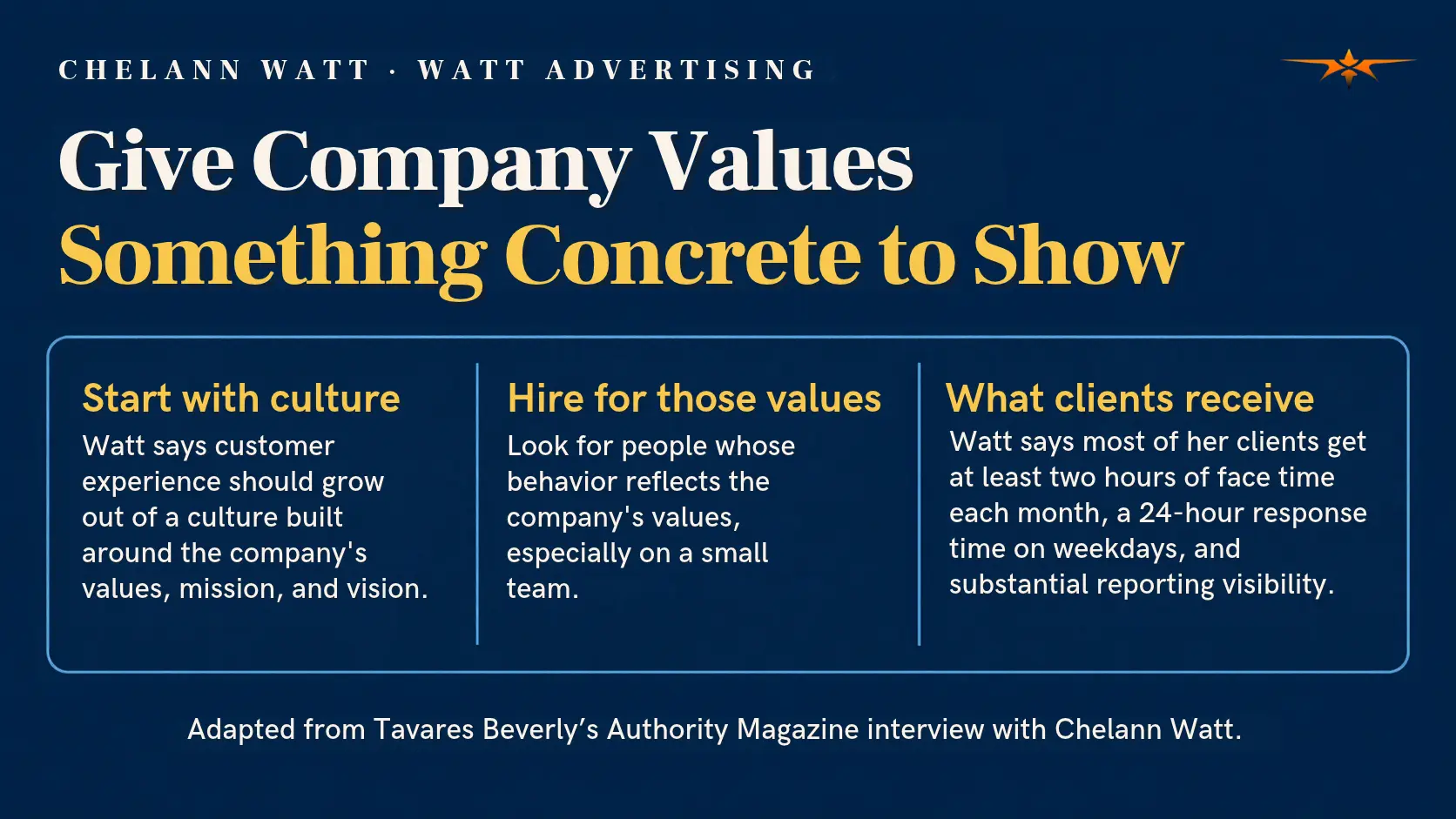
Give Company Values Something Concrete to Show
Watt’s first recommendation was to establish real substance through a company’s values, mission, and vision. She described good customer experience as something that should emerge from the culture a business has developed. Her second recommendation concerned hiring people whose behavior aligns with those values, particularly on a small team where one person can disrupt the culture.
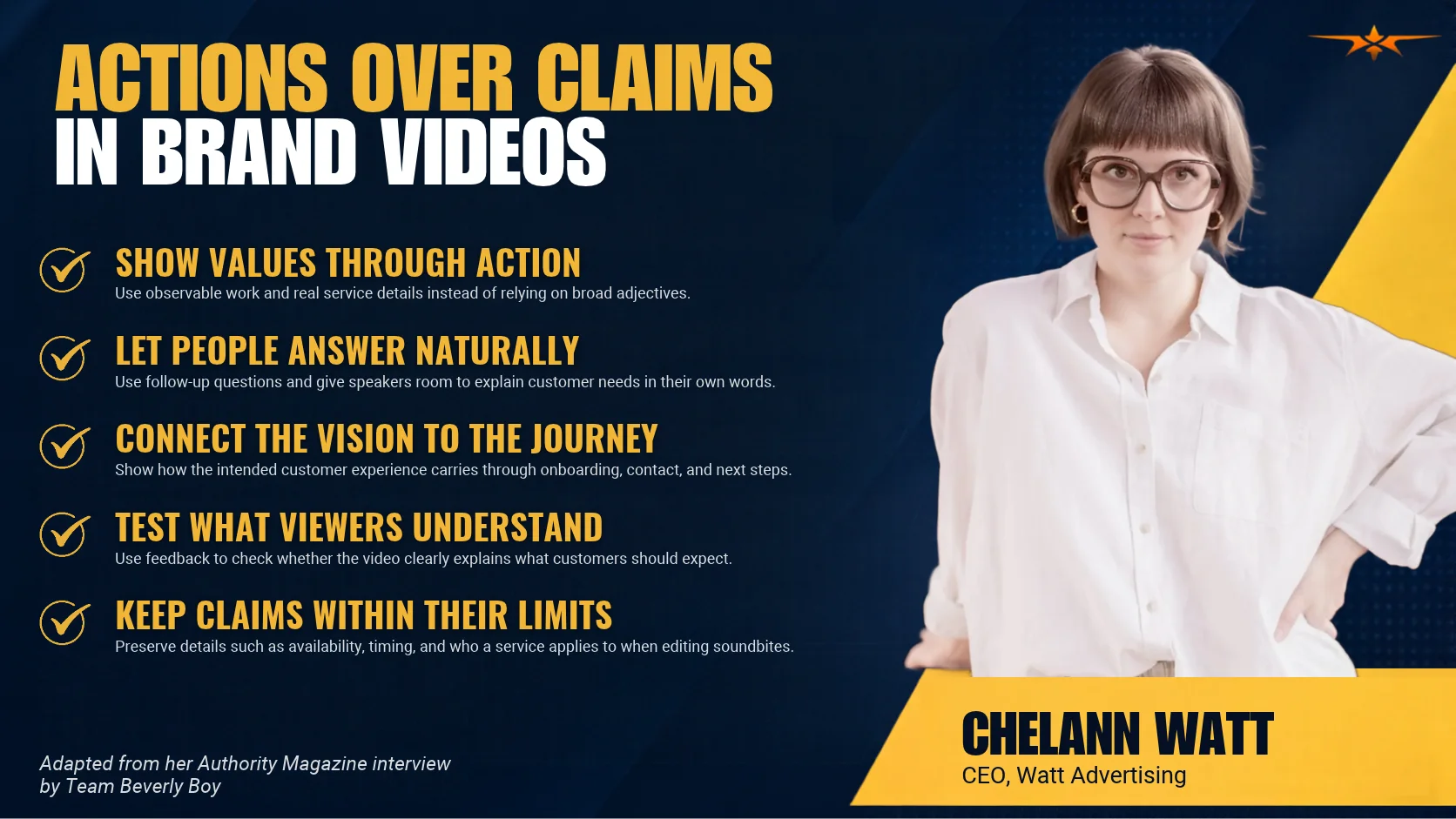
For a brand video, that suggests beginning with observable work rather than a list of adjectives. Before writing narration about attentiveness, a producer should ask which employee actions demonstrate it. The answer can guide the footage: an explanation of a report, a conversation about a customer’s concern, or another actual service interaction appropriate to film.
Watt supplied concrete details about her own company’s service: most clients receive at least two hours of face time each month, a 24-hour response time on weekdays, and substantial reporting visibility. These are her descriptions of Watt Advertising, not standards another business should borrow for its script. A company’s video should draw its supporting details from the service that company actually provides.
Leave Space for the Person Behind the Answer
Asked why businesses neglect customer experience, Watt said the human element takes effort. People and situations vary, and a particular situation may require a custom response. She also said business owners can become absorbed in operations and lose sight of the people they serve.
That observation has a direct application to filming customer-facing employees. An interview guide should leave room for follow-up questions instead of requiring everyone to deliver the same prepared statement. When a speaker mentions helping a customer, the interviewer can ask what the customer needed explained and how the employee responded. Those details give the audience something more specific than a declaration of commitment.
The director should also distinguish between an incomplete answer and an answer that simply arrives in the speaker’s own language. Repeating takes solely to match a script can remove useful detail. A clearer question may be more productive than asking the employee to reproduce marketing copy, particularly when the purpose of the interview is to explain how people handle individual customer needs.
Connect the Service Vision to the Customer’s Actual Journey
Watt described a five-star luxury British hotel as the inspiration for her company’s client experience. She then explained how the company was formalizing practices around that vision. Her examples included a handwritten leadership letter with a wax-stamped envelope and a sensory-focused gift when a client signs on, followed by processes intended to maintain that feeling throughout the relationship.
The useful production connection is the relationship between an intended experience and its supporting details. A business should decide what an onboarding video needs to help a new customer understand before choosing its visual style. If personal attention is the stated aim, the video can identify the person responsible for the relationship and explain how contact works.
This also gives producers a reason to examine the order of information. A welcome message can introduce the relationship, while the next portion explains what happens after sign-up. Attractive imagery may support the tone, but it cannot explain a handoff or a next step by itself. The service vision should influence the structure of the video as well as its appearance.
Use Customer Feedback to Test the Video’s Explanation
Watt’s fifth recommendation was to put intentions into practice and track results through client surveys or a feedback loop. Elsewhere in the interview, she described a PR agency client’s survey response that mentioned reporting, personalization, and listening. The account illustrates the value she places on hearing which parts of service clients recognize.
For businesses using video marketing, a related application is to review whether customers understand the explanation on screen. A producer can ask a small group of intended viewers to watch an onboarding video and describe what they believe happens next. Their responses can reveal an unclear instruction or a missing explanation before the business treats the video as finished.
Keep that review focused on the video’s assigned job. Asking whether viewers liked the presentation is different from asking whether they can identify their contact or explain the next step. The latter gives an editor a concrete revision decision without treating favorable reactions as proof that the underlying service is working.
Team Beverly Boy’s Takeaway

We think an editor has a particular responsibility when a customer-service soundbite becomes broader than the speaker’s full answer. A concise statement can lose the limits that made it accurate. In this kind of video, preserving those limits matters more than choosing the most assertive line.
We would make that judgment during the rough cut, comparing the selected excerpt with the surrounding answer. If a speaker describes a service available to most customers or during certain hours, we would retain that context in the spoken edit or accompanying text. We would choose a longer, accurate explanation over a shorter promise the business did not make.
A customer experience video sits alongside a relationship that continues after playback. Its most useful contribution is to give customers an accurate understanding of that relationship, with enough detail to know what the company means by the service it describes.
This article is based on an interview originally published by Authority Magazine. Read the full interview here.