Roy Danino on Why Business Outcomes Should Guide Video Production
Roy Danino, co-founder of Lachi Media, discussed video strategy with Authority Magazine through the lens of paid advertising and business results. The conversation covered what happens after someone watches or clicks, including the sales conversations that reveal why an interested prospect has not bought.
For businesses commissioning video, the interview offers a useful basis for production decisions. Video testing becomes more informative when the shoot and edit are organized around a defined question. That changes what belongs in the brief, which details need screen time, and what material should be available for subsequent versions.
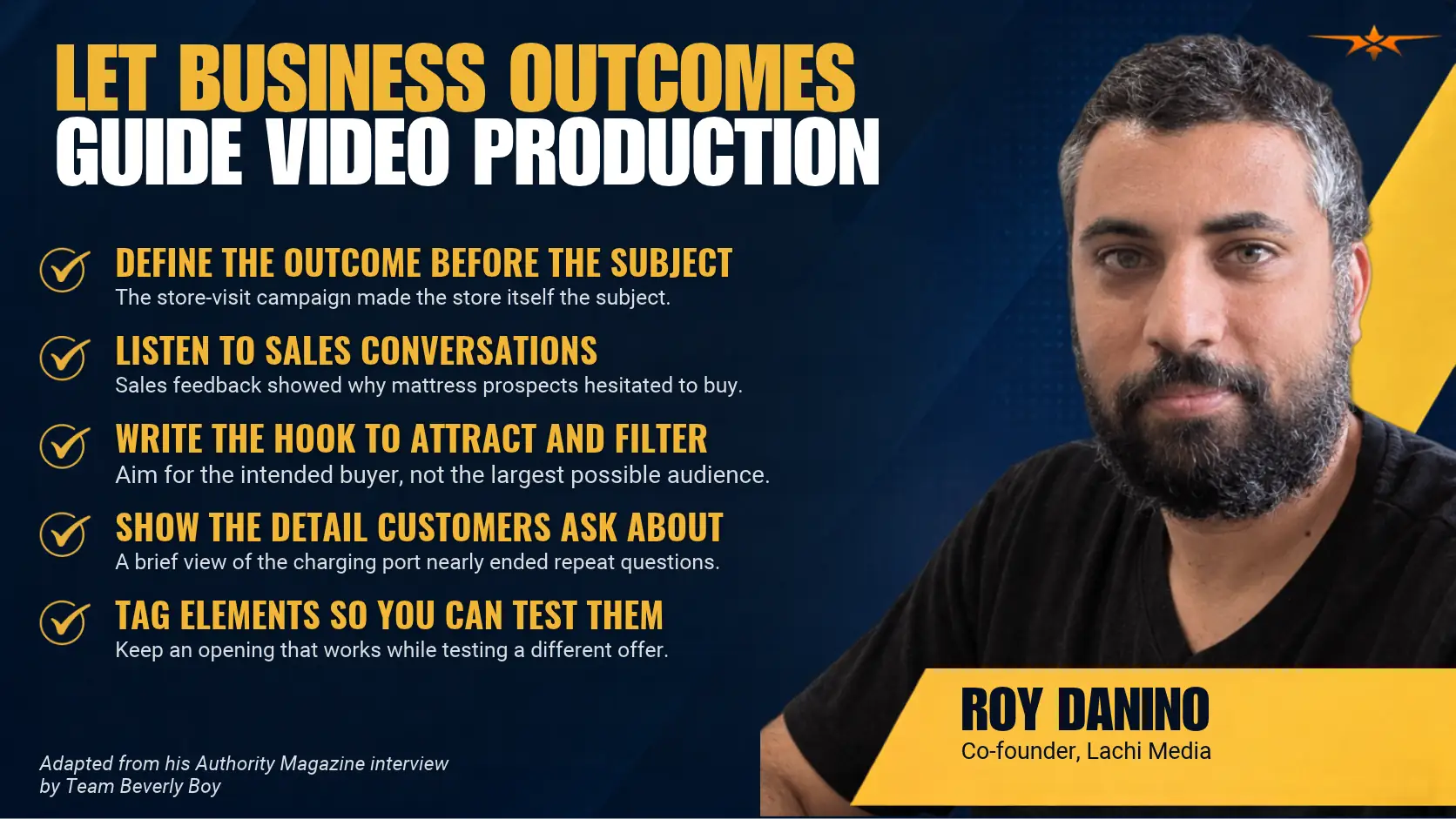
Define the Business Outcome Before Choosing the Subject
Danino described a music store that sold online but also wanted visitors to its physical location. Its eCommerce advertising featured products or product categories. For the local campaign, the store itself became the subject, including its stock, staff service, pedal-testing room, and address. His team compared store visits before and during the campaign and tracked loyalty-program registrations. He explicitly noted that neither measure alone proved causation.
A production brief should make that distinction before anyone writes a shot list. A product-focused ad needs footage that explains the item; a store-visit video needs to make the location and reasons to visit understandable. The producer should ask the business owner what action the finished piece is meant to support, then identify the footage needed for that purpose. A visually complete product demonstration can still leave a local campaign without the location information it needs.
Let Sales Conversations Identify the Missing Explanation

Danino recalled a mattress company whose prospects hesitated to purchase without feeling the mattresses first. A thirty-day trial did not resolve that concern. Sales feedback informed a video showing the company’s display center and reseller display centers, with an invitation to book a visit. The obstacle was something the lead count alone could not explain.
That example gives interview preparation a concrete starting point: review recurring sales questions before selecting topics. A producer should distinguish between a request for more product information and uncertainty about how to evaluate or buy the product. Those are different filming assignments. When the unresolved issue concerns trying something in person, another description of its benefits may leave the question unanswered. The video needs to explain the available evaluation step clearly enough for the viewer to act on it.
Write the Opening for the Intended Buyer
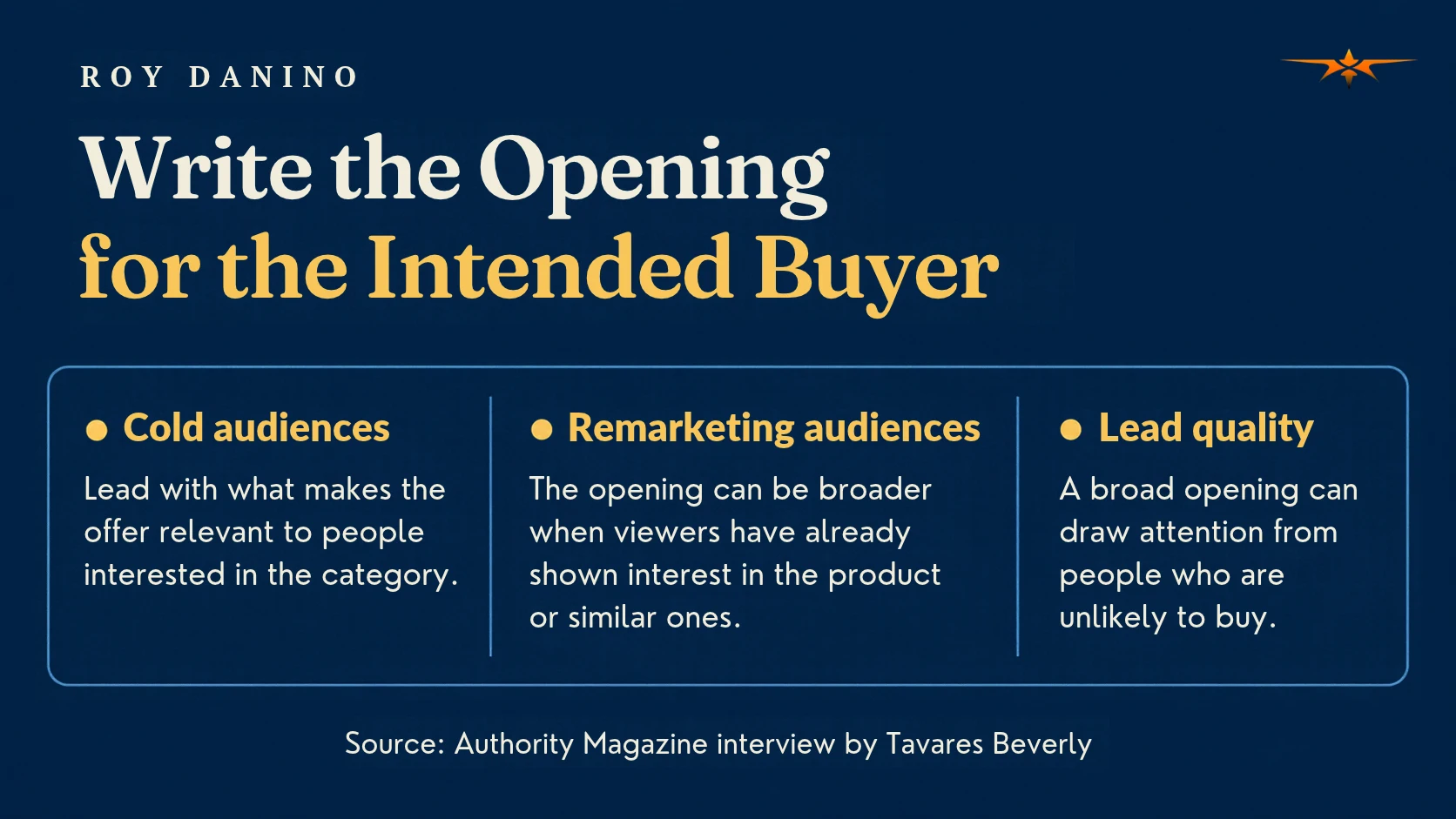
Danino said a hook should attract and filter, rather than pursue the largest possible audience. He distinguished cold audiences, which may need category-specific context, from remarketing audiences whose previous behavior has already supplied some filtering. His concern was that broad attention could improve early metrics while bringing in people unlikely to buy.
Script development should therefore include a specific question about the opening: what tells the intended customer this offer applies to them? The first spoken line and first image should provide relevant context before relying on curiosity or a discount. For cold-audience ads, an editor should avoid withholding the product category merely to create suspense. That is a production judgment about what information belongs early, not a promise that a narrower opening will automatically improve sales.
Give Small Product Details Enough Screen Time
A beauty brand in Danino’s account had a performing product video but continued receiving questions about its charging port. The product used USB-C, which customers preferred during a transition away from Micro-USB. His team added a brief view of the port to an otherwise nearly identical ad. Danino reported that questions almost disappeared overnight and sales were nearly thirty percent higher after launch.
The relevant production application is precise: add unresolved product details to the coverage list. A close-up should show the feature at a readable angle and remain visible long enough to understand. It does not necessarily need a separate explanation or a new section of the script. The source example concerns one connector, so it supports checking for specific information gaps rather than assuming that additional detail will improve any product video.
Capture Variations That Can Answer a Testing Question
Danino described breaking videos into identifiable elements and tagging them consistently. If an opening attracts the intended audience but an offer underperforms, he suggested retaining the opening while testing another offer. Looking ahead, he recommended modular creative libraries and said AI could help assemble and adapt combinations, while organized inputs and measurement would still matter.
A shoot should capture alternatives that correspond to a useful comparison. Record distinct openings as separate takes, and keep their identities clear in the production notes and media organization. The editor can then change the intended element without accidentally changing several others. This gives the business a more interpretable comparison than several loosely related cuts. It also makes the footage easier to retrieve when a later result raises a specific question about the offer or opening.
Match Deliverables to the Viewing Environment
Danino advised choosing distribution after defining the video’s purpose. He also cautioned against simply resizing the same video for every channel, noting that viewing behavior differs across platforms. His advice about filming horizontally with room for alternate crops addresses capture flexibility, but his broader point includes how the finished message fits its destination.
Before filming, businesses should identify the intended placements and ask the production team to distinguish crop adaptations from separate edits. A crop changes framing; a placement-specific edit may require a different opening or amount of explanation. The deliverables brief should name those differences so the shoot captures what each version needs. This applies the interview’s outcome-first thinking to a concrete scope decision without treating one master video as sufficient for every use.
Team Beverly Boy's Takeaway

We think the editor has a particular responsibility when modular footage becomes multiple ads: check that each assembled version preserves the meaning of the recorded statements. An opening paired with a different offer can imply a promise that neither segment made on its own.
We would make that a review step before export. We would read each assembled script as a complete claim and hold any combination whose wording or demonstration no longer supports the offer being presented.
A useful production plan leaves room for learning while keeping each finished version understandable and accurate. More versions have limited value if the business cannot identify what each one is saying.
This article is based on an interview originally published by Authority Magazine. Read the full interview here.