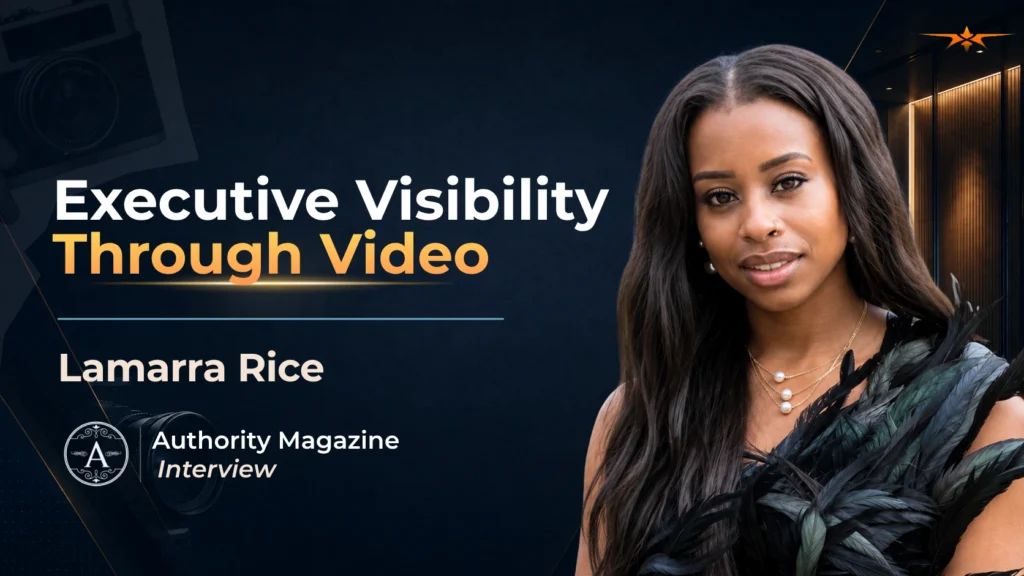
What Video Teams Can Learn from Lamarra Rice on Executive Visibility
Executive visibility is often treated like a content problem: film the CEO, publish more clips, and increase exposure. But Lamarra Rice’s interview suggests something more useful for video production: visibility becomes valuable when the leader’s message, company direction, and production system all mature together.
Rice is the founder and CEO of GCPR HQ, a strategic communications firm focused on visibility, credibility, and influence. Her career has been shaped by storytelling, media, positioning, and the question of why certain people or companies become part of the conversation while others are overlooked.
For Beverly Boy Productions, that creates a clear production idea: executive video should not simply record leadership. It should help the organization turn leadership thinking into a repeatable communication asset that can evolve as the business changes.
Visibility Should Follow Business Direction
Rice says visibility is not about becoming famous. It is about making sure the right people know who you are, what you do, and why it matters.
That changes how an executive video should be planned. A founder interview for recruitment, investor communication, customer trust, or industry authority may feature the same person, but the production goal, supporting footage, questions, and final edit should be different.
The production brief therefore needs to answer more than “What should the CEO say?” A stronger question is: Which audience needs to understand this leader differently after watching?
The Leader’s Message Has to Grow With the Company
Rice describes how her role changed as GCPR expanded. She moved from concentrating on clients and execution toward thinking about systems, positioning, people, technology, and long-term direction.
That suggests an important video-production principle: executive content should evolve with the stage of the company. Early founder videos may explain the origin story, while later content may need to communicate market direction, leadership philosophy, culture, strategic choices, or where the company is heading next.
For Beverly Boy, that means a recurring executive series should not become a collection of interchangeable talking-head clips. The editorial direction should change as the leader’s responsibilities and the company’s priorities change.
Executive Content Needs a System, Not More CEO Tasks
Rice learned that being capable of doing everything did not mean she should continue doing everything. Delegation and systems became necessary as her role shifted from doing the work to building the infrastructure around it.
The same logic applies to leadership content. If the executive has to invent every topic, schedule every recording, review every technical detail, and coordinate every edit, visibility becomes another operational burden rather than a communication advantage.
A stronger production system separates expertise from execution. Beverly Boy can handle pre-interviews, shoot planning, crews, filming, B-roll, and post-production while the executive focuses on the ideas and decisions only they can articulate.
Do Not Mistake Content Volume for Communication Progress
Rice distinguishes between being busy and actually building. She notes that constant meetings, emails, and activity can feel productive without advancing what matters most.
Executive video can fall into the same trap. A company may publish frequently while repeating the same generic leadership language, producing clips that add output without adding clarity.
The better measure is whether the content is building something specific: greater understanding of the company, stronger trust in leadership, clearer positioning, better recruiting, or a more recognizable point of view. One well-developed executive session can be more valuable than a large volume of disconnected clips.
Preserve the Point of View Without Turning It Into a Committee
Rice says not everyone will understand a founder’s vision immediately and that leaders cannot build the entire company around receiving everyone else’s approval. She also emphasizes the need to listen while still trusting the direction of the vision.
That tension matters in executive video review. Legal, communications, marketing, and other stakeholders may need to protect accuracy and risk, but too many revisions can flatten the leader’s perspective until the final message sounds like no one in particular.
Beverly Boy’s production application is to preserve the executive’s natural language and central argument while structuring review around factual accuracy, brand alignment, and communication risk. The goal is not unfiltered spontaneity, but a credible voice that still belongs to the person on screen.
Use Video to Show the Direction, Not Just Explain It
Rice says leadership requires thinking beyond today’s task list, protecting the vision, and creating an environment where others can do their best work. She also describes the CEO’s role as leading the direction rather than simply leading the work.
That creates a stronger visual opportunity than another seated interview alone. If leadership is talking about growth, culture, innovation, customer service, or operational change, the production can capture the people, environments, and processes that demonstrate those priorities.
This is where B-roll becomes evidence rather than decoration. The executive establishes the direction, while the footage shows what that direction looks like inside the organization.
Build for Decisions Made Without Perfect Information
Rice says CEOs rarely have complete information and must learn to make the best decision available, move forward, and adjust as new information appears.
That is a useful model for recurring video strategy. A company does not need to predict the perfect interview format, campaign structure, or executive series before filming the first piece.
Beverly Boy can help clients test a focused production, review what works, and refine the next round. That turns executive video into an iterative communication program rather than a large one-time commitment that has to be perfect before it begins.
Make Visibility Credible With Proof
Rice’s communication philosophy also emphasizes observing behavior rather than relying only on what people say about themselves. She notes that behavior often reveals more than self-description alone.
That principle is especially useful in corporate video. If an executive says the company values collaboration, quality, service, or innovation, the production should look for footage that supports the statement through actual work, people, environments, or customer interactions.
This creates a stronger relationship between interview and image. The leader makes the claim, while the production gives the audience something visible that helps them judge whether the message feels credible.
Turn Leadership Communication Into a Production System
Beverly Boy Productions can help organizations build executive visibility through founder stories, leadership interviews, company updates, thought-leadership series, recruiting messages, corporate films, and short-form executive content. A single planned production can also generate multiple versions for websites, LinkedIn, internal communications, sales materials, and future campaigns.
If your leadership team has a clear point of view but needs a stronger system for communicating it on video, Beverly Boy can help turn that expertise into a production plan, from pre-interviews and crew coordination through filming, B-roll, editing, and platform-specific deliverables.
Team Beverly Boy’s Takeaway
Rice’s interview suggests that executive visibility works best when it reflects how leadership actually operates. As the company grows, the message, production structure, and visual evidence should grow with it.
For Beverly Boy, the opportunity is not simply to make leaders more visible. It is to help make their direction easier to understand, recognize, and trust.
Conclusion
Executive video becomes more valuable when it functions as part of the company’s leadership system rather than as another marketing task. Rice’s perspective shows that strong visibility comes from clear direction, a credible point of view, and a production process capable of turning leadership thinking into communication people can actually see.
This article is based on Lamarra Rice’s Authority Magazine interview with Tavares Beverly. Read the full interview on Medium.