Antons Davis on Adapting Video Production When the First Plan Fails
Video productions rarely go exactly as planned. A concept may test poorly, a speaker may struggle on camera, a location may fall through, or a client may discover that the original approach is not producing the result they expected.
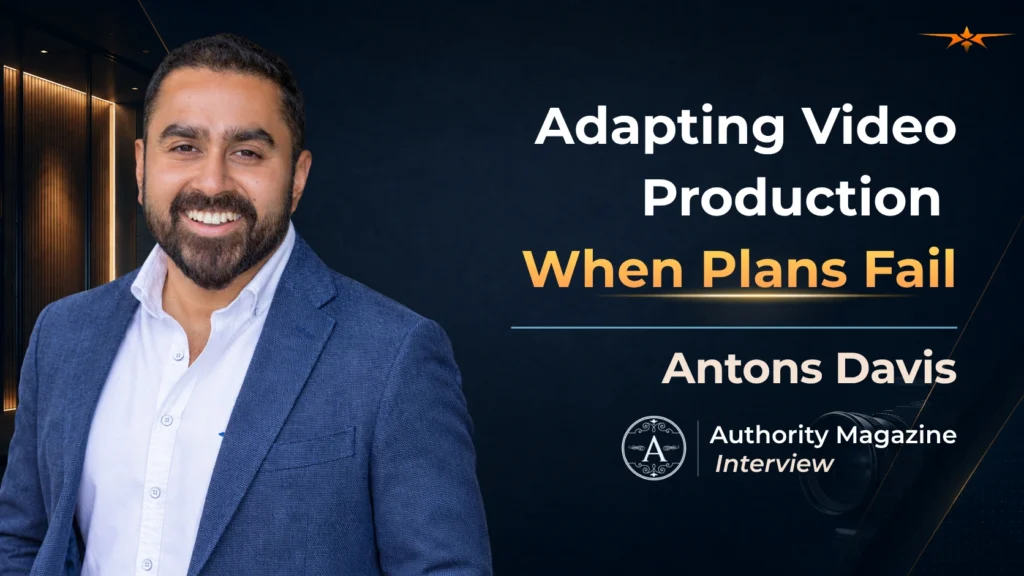
Antons Davis is the founder of Osmo, an AI-powered coaching platform that combines his background in technology, design, and coaching. His Authority Magazine interview focuses on what happens when an original plan meets resistance, especially when adoption is slower than expected, outside dependencies create problems, or the founder becomes too attached to doing everything a certain way.
For Beverly Boy Productions, those lessons point to a clear production principle: plan carefully, test important assumptions early, and stay flexible enough to change the method without losing the objective.
Test the Assumption Before Scaling the Production
After launching Osmo, Davis was frustrated by the lack of user adoption. He realized he had underestimated the difficulty of asking coaches to change established behavior, rather than simply switch from a competitor.
Video projects can carry similar hidden assumptions. A client may believe an executive should deliver a scripted message or that one concept will work across several audiences, but a pre-interview, camera test, or sample edit can reveal problems before the full crew and post-production budget are committed.
For Beverly Boy, a smaller test can help evaluate the speaker, format, and creative direction before committing to a larger production.
Keep Decision-Making From Becoming a Bottleneck
One of Davis’s five obstacles is the need to do everything yourself. He explains that trying to approve every decision may protect the original vision at first, but eventually the founder becomes the bottleneck while the project expands into areas beyond one person’s expertise.
That same problem appears when every script line, camera choice, graphic, and edit has to return to one executive. A stronger production structure gives the client ownership of the business objective and factual accuracy while allowing the producer, director, DP, sound team, and editor to make informed decisions within that direction.
Clear ownership keeps the project moving without weakening the client’s vision.
Use Feedback to Identify What Needs to Change
Davis admits that criticism can feel personal because the business is closely tied to the founder. He also describes self-doubt as one of entrepreneurship’s most persistent challenges.
Creative review needs more distance. A rough cut that feels slow may need a stronger opening, a stiff interview may need a different edit or delivery approach, and weak audience response may point to a problem with the message rather than the entire production.
Beverly Boy can help identify whether feedback calls for a focused edit or a broader change to the production approach.
Build Enough Flexibility Into the Plan
Davis says his financial runway gave him space to make better decisions instead of reacting under immediate pressure. That buffer allowed him to consider what was best for the company rather than being forced into rushed choices.
Production needs its own version of that margin. A schedule with no contingency for talent delays, weather, technical issues, or additional setup time can turn a manageable change into an expensive problem.
Realistic scope and scheduling give the crew room to protect quality when conditions shift.
Change the Method When It Stops Serving the Goal
Davis initially expected to meet Osmo’s scheduling needs through a third-party integration such as Calendly. When those options proved limiting, he built a scheduler from scratch, which he says enabled enterprise offerings and additional integrations.
That maps directly to production. A teleprompter may need to become a conversational interview, a planned location may need replacing, or an elaborate visual treatment may need simplifying if it no longer serves the message.
Davis also warns against an inflexible “my way or the highway” mentality and emphasizes learning from people with deeper expertise in certain areas. For Beverly Boy, the objective stays fixed while the crew remains free to find a better route to the finished result.
Let Specialists Strengthen the Original Vision
Davis credits advisors with helping him understand that finding the right fit could require adaptation rather than stubbornly defending the first solution. He also recognizes that projects eventually grow into areas beyond the founder’s own skills.
A production crew should provide that same kind of leverage. A DP may identify a stronger visual approach, an editor may find a clearer story structure, or an interviewer may uncover a better answer than the scripted version anticipated.
The value of experienced production is not simply executing the first idea exactly as written. It is helping the client reach the original objective with stronger creative and technical decisions.
Turn an Uncertain Production Into a Practical Plan
Beverly Boy Productions can help organizations move from an early concept to a more resilient production plan through pre-interviews, camera tests, crew coordination, location filming, executive and customer interviews, B-roll, multi-camera production, editing, and alternate deliverables.
If your project has a strong idea but the speakers, format, scope, or production approach still need to be tested, Beverly Boy can help identify the most practical way to film it before those uncertainties become expensive shoot-day problems.
Team Beverly Boy’s Takeaway
Beverly Boy’s production takeaway from Davis’s experience is to stay open to different methods while checking that the objective still serves the client’s needs. Strong production keeps the objective clear while giving the team enough flexibility to respond when reality provides better information.
Conclusion
The first production plan is a starting point, not something that has to survive unchanged. Davis’s experience highlights the value of adaptability and outside expertise. Beverly Boy can apply those principles through early tests, clear decision ownership, and adjustments guided by what the production reveals.
This article is based on Antons Davis’s Authority Magazine interview with Tavares Beverly. Read the full interview on Medium.