
Joseph Rako on Building a Short-Form Video Strategy
Short-form video works best when it is part of a system, not a reaction to whatever platform is popular that week. Brands still need a clear identity, a defined audience, a realistic production rhythm, and a way to review what is actually working.
Joseph Rako is the founder of RAKO Media, a Melbourne-based social-first agency that helps businesses build organic audiences through short-form video. His work spans planning, scripting, shooting, and editing, with roughly 80% of his client work focused on short-form video.
Beverly Boy Productions can apply these ideas through audience-focused planning, interview direction, filming, and editing for a recurring short-form series.
Know the Brand Before Writing the Content
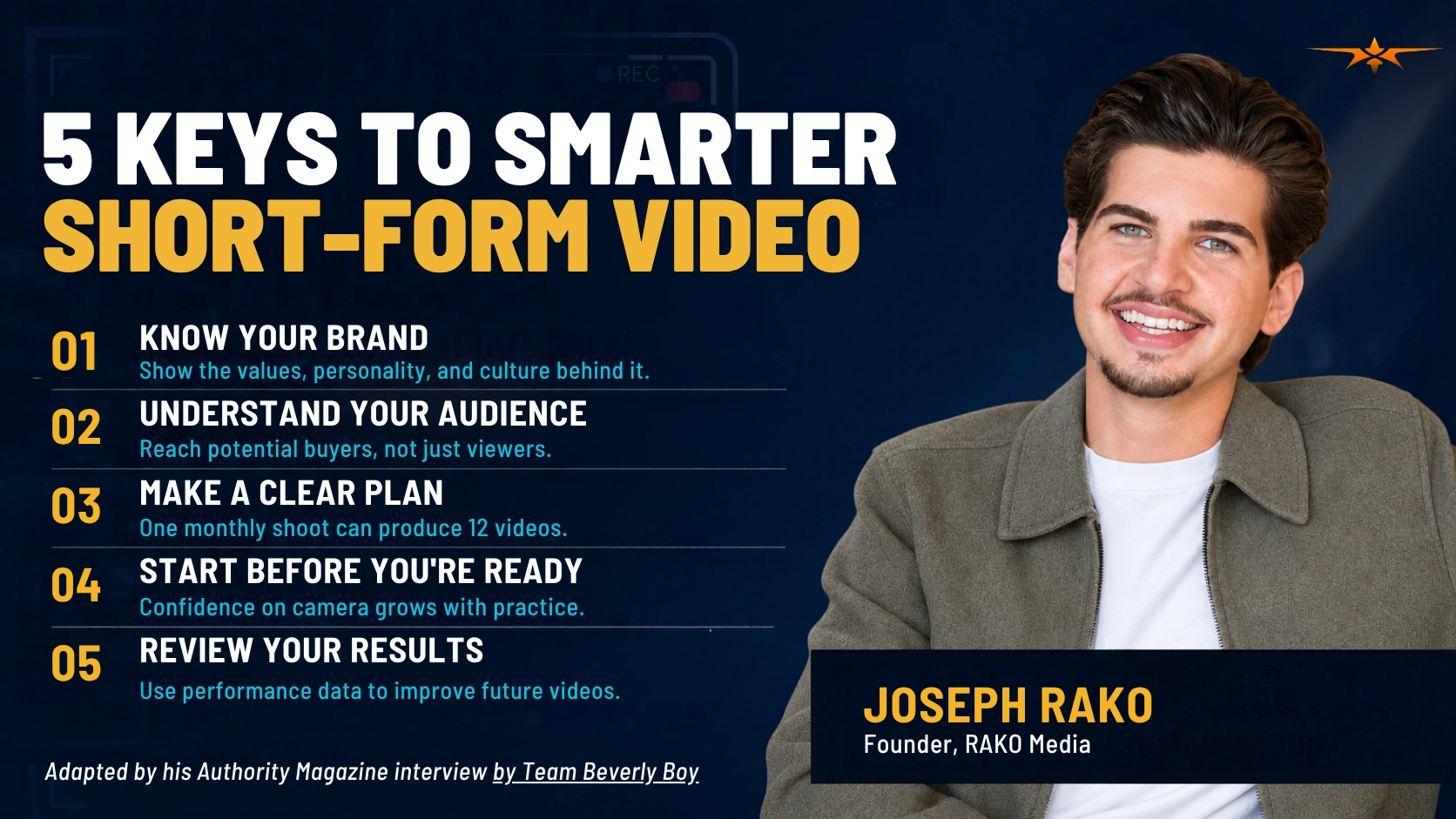
Rako’s first formal recommendation is to understand exactly who the business is, including its values, personality, visual identity, culture, and the details that make it distinct. He points to St Andrews Hotel, where knowing the family-run pub from the inside made it easier to bring its quirks, stories, and culture into the content.
For a production partner, that discovery work can happen before cameras arrive. Beverly Boy can use client interviews, existing brand materials, location discussions, and pre-interviews with likely speakers to identify the people, settings, and stories worth capturing.
Those decisions then shape the actual shoot. Instead of arriving with generic prompts, the crew can plan interview questions, B-roll, visual details, and locations around what makes the business recognizable.
Make Sure the Right Audience Is Watching
Rako warns that strong numbers can still represent weak marketing if the wrong people are watching. He describes an HR and recruitment client whose content attracted employees rather than the business owners who would actually purchase the service.
Audience clarity should therefore influence more than the script. It can affect who appears on camera, which customer problems are discussed, what demonstrations are filmed, how technical the language should be, and which clips deserve priority in post-production.
For Beverly Boy, that creates a more focused brief for both the shoot and edit. The objective is not simply to produce engaging video, but to capture material that speaks to the viewers the client actually needs to reach.
Separate Reach Content From Trust Content
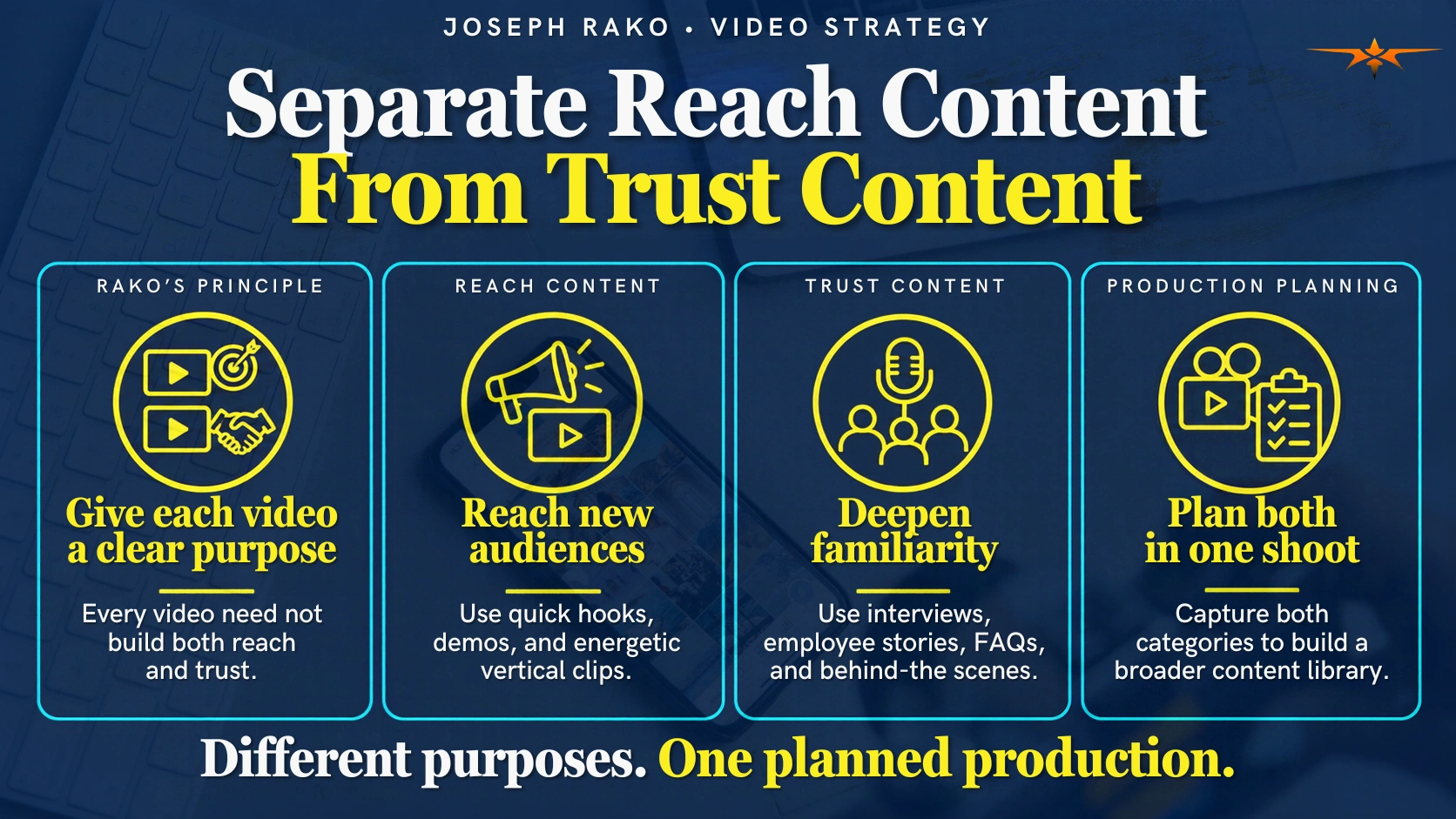
Rako pushes back on the idea that every video must generate both reach and trust at the same time. Some videos are designed to get a brand in front of cold audiences, while others should explain the company, introduce its people, and deepen familiarity once viewers already recognize it—a distinction that aligns with a video content sales funnel.
That distinction can guide the production mix. A shoot might include quick hooks, visual demonstrations, or energetic vertical clips for discovery, alongside executive interviews, employee stories, FAQs, and behind-the-scenes material designed to build credibility.
Beverly Boy can capture both categories during the same production when they are planned in advance. That gives the client a broader content library without forcing every asset to serve the same purpose.
Build a Production Rhythm the Client Can Maintain
Rako recommends a simple plan rather than an intimidating strategy document. His example is one two-to-three-hour shoot day each month that produces roughly 12 videos, followed by consistent posting and month-to-month review.
The broader production lesson is to build around a cadence the business can realistically sustain. Beverly Boy could support that with recurring content days, where several speakers, topics, customer questions, and visual setups are scheduled into one efficient shoot.
That service model can include pre-production planning before each session, professional camera and audio capture, B-roll where needed, and post-production of multiple vertical assets. The goal is to create a repeatable pipeline instead of rebuilding the production process from zero every time the client needs a Reel.
Make On-Camera Comfort Part of the Service
Rako admits that his first attempts speaking directly to camera felt awkward and difficult. He says the confidence people now see came from repetition rather than natural ability.
That is where production support can make a major difference for owners and executives who are knowledgeable but inexperienced on camera. Beverly Boy can use pre-interviews, conversational prompting, shorter takes, talking points, teleprompter support, or interview-style delivery depending on what helps the speaker communicate most naturally.
The crew can also manage the technical distractions around the speaker. When lighting, framing, sound, and camera operation are handled professionally, the subject can focus more fully on the message.
Start With Questions Customers Already Ask
For leaders unsure what to say, Rako recommends beginning with the questions customers already ask. The business already has the expertise to answer them, and the content does not need to start with an elaborate concept or heavy edit.
Those questions can become the foundation of a production outline. Before the shoot, the client can provide common FAQs, objections, misconceptions, and topics that repeatedly come up in sales or customer service.
Beverly Boy can then structure those ideas into a filming plan with clear prompts and several short segments. One session can produce standalone answers while also generating material for longer edits, compilations, or supporting social content.
Use B-Roll to Keep Short-Form Content Visual
As a production application, Beverly Boy can capture B-roll that supports each answer, such as kitchen activity, construction work, or team interactions. This gives editors footage to clarify the subject and vary the visuals across a series.
Review Performance Before the Next Shoot
Rako’s fifth formal principle is to review results instead of continuing the same content indefinitely. With The Butcher Club, he replaced consistently weak promotional posts with an additional Reel each week, after which monthly views increased substantially.
For recurring production, that review can influence the next shoot brief. If certain speakers, questions, hooks, or visual formats consistently outperform others, more filming time can be assigned to them the next time the crew returns.
This creates a useful production cycle: plan, shoot, edit, review, then adjust the next session. Over time, the service becomes more focused because actual audience response helps determine what deserves continued production.
Keep Human Creativity Visible
Rako expects AI to make video creation cheaper and easier, but argues that easier production will make simply producing something less distinctive. He believes real people, real stories, creative judgment, and strong execution will become more valuable as AI-generated content becomes more common.
That makes professional production especially valuable when the goal is to show the real business behind the content. Genuine interviews, recognizable locations, employee personalities, customer interactions, and original footage give brands material that cannot be replicated simply by generating another generic video.
Team Beverly Boy’s Takeaway
Rako’s strongest production lesson is to connect strategy with a sustainable filming schedule. Beverly Boy can apply it by planning around the client’s audience, capturing useful answers and supporting footage, and adjusting future shoots based on results.

Conclusion
A strong short-form video strategy needs a production process the business can maintain. Rako’s framework offers a practical sequence for Beverly Boy clients: clarify the brand and audience, plan the shoot, start filming, and review results.
This article is based on Joseph Rako’s Authority Magazine interview with Tavares Beverly. Read the full interview on Medium.
