
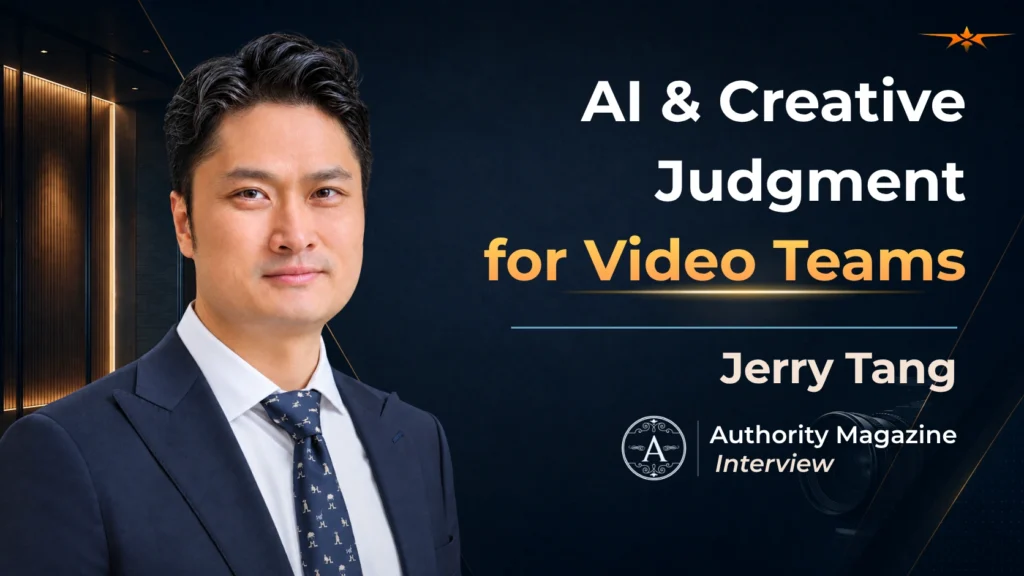
Jerry Tang on AI and Creative Judgment: Lessons for Video Teams
AI can make video faster and less expensive, but easier production does not automatically create better work. As more brands gain access to the same tools, the advantage shifts toward the people who know what deserves to be made, how it should look, and why an audience should remember it.
Jerry Tang is founder and CEO of Atlas Cloud, a generative media company providing access to image, video, text, and audio AI models through a single API. His Authority Magazine interview focuses directly on how AI is changing video production while making creative judgment, audience knowledge, and experienced specialists more important.
Beverly Boy Productions can apply Tang’s emphasis on creative judgment to projects combining filmed footage and AI-assisted elements. This hybrid approach is Beverly Boy’s interpretation, not a model Tang specifically recommends. For projects requiring documentation of actual people, products, or events, crews can capture source footage while AI supports selected creative tasks.
Start With the Production Brief, Not the Tool
Tang argues that leaders often treat video as a production problem when the harder issue is clarity. Before thinking about cameras, studios, or AI tools, a brand needs to know the impact it wants to make or the point of view it is willing to defend.
Beverly Boy can help turn a broad request such as “we want an AI video” into a shootable brief. That means identifying the audience, core message, call to action, distribution needs, available spokespeople, required locations, and which elements actually benefit from AI instead of forcing the technology into every part of the project.
From there, the production can separate what needs to be filmed from what can be designed or generated later. An executive interview, factory process, customer interaction, or real product demonstration may require live coverage, while concept frames, stylized transitions, or certain visual effects may be explored with AI-assisted tools.
Build the Crew Around the Work That Must Be Real
Tang’s first formal recommendation is to get the team right before obsessing over the concept. He argues that even a strong idea has little value if there is no one capable of executing it well, on time, and repeatedly.
For Beverly Boy, that means matching crew roles to the parts of the production that still require specialist judgment. A producer can manage logistics and client communication, a director can protect the story and performance, a DP can shape lighting and framing, and sound and camera crews can capture clean source material that gives post-production more flexibility.
If the project includes AI-generated or heavily composited elements, the live-action team can also shoot with those needs in mind. Framing, eyelines, backgrounds, lighting direction, camera movement, and clean plates may need to be planned differently when footage will later interact with generated material.
Decide What Deserves a Full Production
Tang describes two valid approaches: frequent content and distinctive creative work. He says AI lowers production costs for both; Beverly Boy’s crew and budget examples below are separate applications to filmed projects.
That distinction can help Beverly Boy scope services more precisely. A recurring social series may use a compact crew, one controlled location, several interview topics, and efficient editing templates, while a flagship commercial or brand film may require location scouting, casting, production design, multiple cameras, specialized lighting, and more detailed post-production.
The production budget can then follow the role of the asset. Clients do not need the same crew or production package for every video, but they do need a deliberate decision about which content deserves deeper investment.
Build Brand Consistency Into the Footage
Tang argues that trust grows when videos repeatedly carry a recognizable voice, perspective, and reason to believe. A viral video does little for long-term authority if the next pieces feel like they came from entirely different companies.
For Beverly Boy, brand consistency can be built into the footage itself. Recurring interview framing, real offices or facilities, recognizable employees, product environments, lighting choices, graphics, and B-roll can create a visual identity that remains connected across multiple campaigns.
Those real assets also give editors stronger material to combine with AI-assisted elements. For Beverly Boy, footage of the client’s actual people, spaces, products, and activities can help make the story specific to that business.
Let Audience Insight Change the Shoot Plan
Tang’s fourth strategy is to understand the audience relentlessly. Format, length, platform, tone, and other creative decisions should trace back to the people the brand is actually trying to reach.
That can change who Beverly Boy interviews and what the crew captures. A technical buyer may need expert demonstrations, close-ups of the product in use, screen recordings, or detailed answers, while a broader consumer campaign may depend more on lifestyle footage, recognizable situations, and shorter emotional storytelling.
Audience needs can also determine deliverables before filming. If the campaign requires vertical social clips, a website hero film, and a longer sales version, framing and coverage should be planned for those outputs on set instead of trying to force one master edit into every format afterward.
Apply Craft as Creative Roles Change
Tang predicts smaller teams with broader expertise, with specialists increasingly judging AI-generated output rather than performing traditional production tasks. He argues that craft remains valuable even as its application changes.
Beverly Boy’s separate application is to match expertise to the project. Filmed interviews require direction and sound recording, while generated sequences require careful evaluation of framing, lighting, audio, and pacing.
Review What the Audience Remembers
Tang argues that views are a weak measure when the audience does not remember who produced the video. His fifth recommendation is to evaluate what the content builds over time rather than what it briefly spikes.
For recurring Beverly Boy productions, those results can shape the next shoot. If audience feedback indicates that a spokesperson, concept, or visual treatment strengthens brand recall, that finding can inform the next production.
That creates a practical production cycle: develop the concept, capture strong source material, integrate technology where it helps, review the audience response, and use those findings to make the next round more focused.
Bring Your AI-Assisted Video Idea Into Production
Have a video concept ready to develop? Contact Beverly Boy Productions to discuss your audience, filming needs, budget, and deliverables.
Team Beverly Boy’s Takeaway
Tang’s strongest lesson is that lower production barriers make judgment more valuable, not less. Beverly Boy’s role is most useful where technology and real-world production meet: deciding what should be filmed, capturing it professionally, and using AI only where it improves the final communication.
Conclusion
Tang’s interview emphasizes capable teams, creative judgment, dependable AI, audience understanding, and brand memory. Beverly Boy can apply those principles to filmed and AI-assisted projects, choosing production methods around the message and audience.
This article is based on Jerry Tang’s Authority Magazine interview with Tavares Beverly. Read the full interview on Medium.
