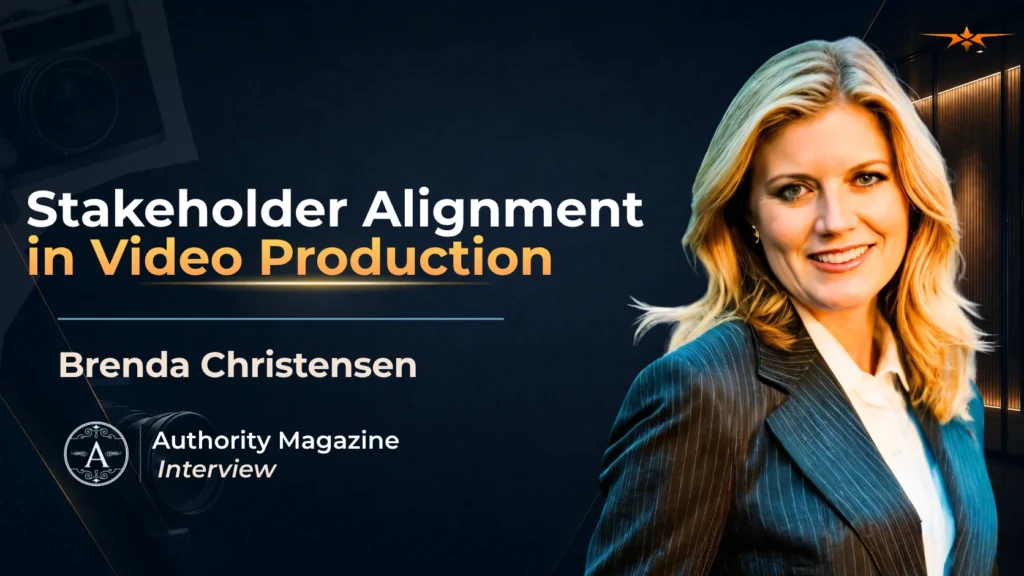
Brenda Christensen on Stakeholder Alignment in Video Production
Video projects become difficult when several stakeholders are involved but no one is sure who has been heard, who owns the message, or whose approval matters most. Strong production communication creates that clarity before conflicting feedback reaches the edit.
Brenda Christensen is CEO of Stellar PR and has worked across strategic corporate leadership, public relations, investor relations, branding, and communications for organizations ranging from startups to Fortune 500 companies. Her Authority Magazine interview centers on listening, proactive alignment, feedback loops, and communication across different levels of an organization.
For Beverly Boy Productions, those ideas apply directly to executive, internal, and stakeholder video. The production process needs to capture the right perspectives early, establish who owns key decisions, and preserve a consistent message through filming and post-production.
Listen Before Locking the Message
Christensen’s first formal strategy is simple: the best communicators are the best listeners. She argues that effective communication begins with understanding stakeholders rather than assuming that speaking more clearly will solve every problem.
For video, that listening can happen during discovery and pre-interviews. Before scripting an executive message, customer communication, or internal update, the team can identify what leadership needs to communicate and what employees, customers, or partners actually need clarified.
Those findings can then shape the interview questions and story structure. The result is a video built around genuine communication needs rather than assumptions from a single department.
Align Stakeholders Before the Shoot
Christensen recommends continually taking the pulse of stakeholders and then connecting what is heard back to corporate objectives. She warns that a passive or reactive approach can allow misalignment to become a larger communication problem.
That makes pre-production the right time to establish the message, factual reviewers, specialist input, and final decision-maker. Marketing, leadership, HR, legal, or other teams may each have valid concerns, but they should not all be directing the production independently.
Beverly Boy can work from an approved brief and consolidated feedback so the crew knows what matters on set and the editor is not trying to resolve strategic disagreements after filming.
Keep Internal and External Messaging Connected
Christensen advises leaders to look from both the top down and the bottom up so gaps do not develop between internal and external communication.
That matters when an organization is producing executive announcements, recruitment content, corporate updates, or public-facing messaging around the same issue. Employees may need more operational detail while customers or partners need different context, but the factual foundation should remain consistent.
Beverly Boy can support that by planning audience-specific versions from the same production. Different edits can change emphasis, runtime, examples, or calls to action without creating conflicting versions of the underlying message.
Prepare for the Production That Changes
Christensen recalls coordinating a press conference for more than 500 journalists when a booking error moved the event from a conference room to a tent in a parking lot. The planned slides and technology demonstration could no longer work in daylight, so the team had to adapt and proceed without them.
Live production carries the same uncertainty. Venues change, executives run late, presentation systems fail, or an important visual element becomes unavailable, which makes backup coverage and flexible production planning valuable.
A Beverly Boy crew can prepare alternate setups, simplified technical options, secondary interview locations, or additional coverage so the core communication can still be captured when the original plan changes.
Use AI for Speed, Keep Human Oversight
Christensen expects AI and automation to take a larger role in communication, particularly for repetitive processes and monitoring. At the same time, she emphasizes the continuing need for experienced human gatekeepers.
For Beverly Boy, one application is human oversight of AI-assisted transcription, captioning, scripting, content repurposing, and review. These production examples extend her communication principles; they are not tools she specifically discusses. These tools can reduce routine work, but people still need to judge whether the message is accurate, appropriate, and consistent with the organization’s intent.
Human review becomes especially important for executive communication, crisis messaging, regulated subjects, and other videos where small wording changes can carry larger consequences.
Turn Communication Strategy Into Production
Once the message, audiences, and approval structure are clear, the communication strategy still has to become a practical shoot. Beverly Boy Productions can support executive interviews, internal communications videos, press events, stakeholder updates, livestreams, multi-camera production, B-roll, and audience-specific edits.
If your organization needs to communicate an important message across employees, customers, partners, or leadership, Beverly Boy can help turn that communication plan into a production built around the people who need to hear it and what they need to understand next.
Team Beverly Boy’s Takeaway
Beverly Boy’s production takeaway from Christensen’s emphasis on listening and proactive alignment is to address stakeholder concerns before cameras roll. An approved brief, clear decision ownership, and ongoing feedback can carry that alignment through filming and post-production.
Conclusion
Video becomes more useful when it helps an organization communicate through complexity rather than adding another layer of it. Applied to video production, Christensen’s perspective highlights the listening, coordination, and adaptability behind a clear message on screen.
This article is based on Brenda Christensen’s Authority Magazine interview with Tavares Beverly. Read the full interview on Medium.