
Ed Crane on Focus, Scope, and Simplicity in Video Production
Extra approvals, unclear ownership, added deliverables, and changing priorities can make video projects harder to manage. Production decisions can also consume time without improving the final piece.
Ed Crane, CEO of Phoenix47, describes leadership as bringing the right people together, making the goal clear, and removing what prevents them from doing their work well. For Beverly Boy, that translates directly to production management, where the producer has to protect the schedule, clarify responsibilities, and keep the team focused on what the shoot and edit actually need.
Protect the Production Critical Path
Crane’s first formal lesson is to protect focus. He describes an 80/20 balance in which most energy should stay on the work that actually moves the business forward instead of being consumed by noise.
For a video project, the critical path includes decisions that can hold up production: finalizing the brief, confirming talent, locking locations, approving the script, securing crew, completing the shot plan, and getting key feedback before the next stage begins. Beverly Boy can separate those decisions from lower-priority preferences so the team does not spend hours refining small details while an unresolved approval threatens the shoot date.
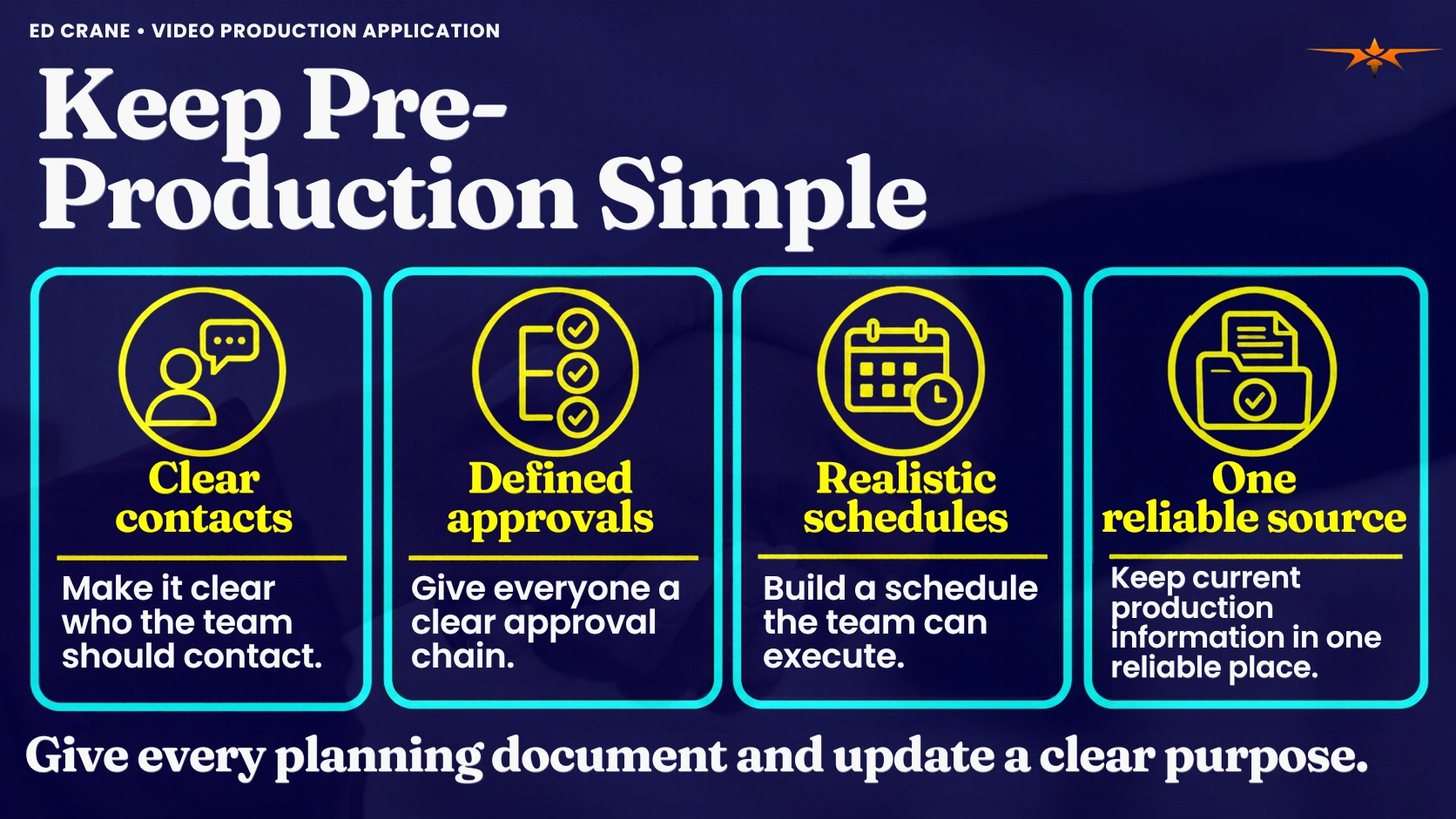
Keep Pre-Production Simple
Crane says complexity increases naturally as organizations grow, especially through extra meetings and activity that make it harder for people to do their actual work. His advice is to keep the process simple enough that the team can still execute.
The same principle applies to pre-production. A project needs clear contacts, a defined approval chain, a realistic schedule, and one reliable place for current information, but adding multiple meetings, duplicate documents, and overlapping feedback channels can create confusion rather than control.
For Beverly Boy, the goal is not to remove necessary planning. It is to make sure call sheets, shot lists, schedules, scripts, client notes, and production updates each have a clear purpose.
Say No to Scope That Weakens the Shoot
Crane says one of his hardest leadership lessons was learning that not every opportunity is good business. Some opportunities may look attractive but can stretch a company beyond its expertise or introduce more risk than value.
Production teams face a similar decision when new requests arrive after the project is already moving. An added interview, second location, extra camera setup, new version, or late concept change may be possible, but each one affects crew time, equipment, scheduling, post-production, or budget.
For Beverly Boy, good scope management means identifying that effect before automatically saying yes. Sometimes the better production decision is to offer a simpler alternative that protects the client’s main objective without destabilizing the rest of the project.
Give Crew Members Clear Ownership
Crane describes the leader’s role as putting the right people together, giving them what they need, and getting unnecessary obstacles out of their way.
On a shoot, that means the producer should not become the decision point for every technical detail. The DP needs room to manage camera and lighting decisions, sound needs ownership of audio quality, the coordinator needs clarity on logistics, and the editor needs an approved creative direction for post.
Beverly Boy can strengthen production by defining those responsibilities before pressure builds. Clear ownership lets specialists solve problems quickly while the producer stays focused on the overall project.
Surface Unknowns Before Shoot Day
Crane’s fourth lesson is that leaders do not need to have every answer. He sees value in asking questions and being open about what is not yet known, as long as the team is prepared to find the answer when it matters.
That is especially important in pre-production. If parking is uncertain, a location has power limitations, an executive’s availability is not confirmed, or the client has not approved a claim, those questions should remain visible rather than being treated as solved.
For Beverly Boy, identifying an unknown early creates time to resolve it. Discovering the same issue after the crew has arrived usually creates a much more expensive problem.
Control Revisions Before Post-Production Expands
Crane says many of his earlier mistakes came from chasing activity that ultimately produced little value. His lesson was that what you choose to pursue matters as much as the work you decline.
The same issue appears in editing when every comment receives equal weight or new ideas are introduced after the creative direction has already been approved. One small change may affect graphics, music, captions, timing, exports, or several deliverable versions.
Beverly Boy can keep post-production efficient by consolidating notes, clarifying who gives final approval, and separating necessary corrections from optional preferences. That keeps revision rounds focused on improving the piece instead of reopening decisions that were already settled.

Remove Production Work That Adds No Value
Crane argues that organizations should eliminate unnecessary meetings, reports, and bureaucracy so people can spend more time solving real customer problems. He also connects simplicity with removing unnecessary complexity instead of constantly adding new initiatives.
For video production, the equivalent is questioning anything that consumes crew or client time without improving the shoot, edit, accuracy, or delivery. That might mean reducing duplicate status calls, limiting unnecessary review rounds, simplifying an overbuilt setup, or cutting a deliverable that no longer supports the campaign.
A leaner workflow gives Beverly Boy more room to focus on the parts that audiences actually experience: preparation, performance, coverage, sound, storytelling, and the final edit.
Team Beverly Boy’s Takeaway
Crane’s strongest lesson for production is that focus has to be protected at every stage. For Beverly Boy, that means keeping pre-production clear, controlling scope, giving specialists ownership, surfacing unresolved questions early, and keeping revisions tied to the approved objective.

Conclusion
Strong production is not about adding more process around the work. It is about removing enough noise that the crew can see what matters, make decisions quickly, and deliver the project without unnecessary complexity.
This article is based on an interview originally published by Authority Magazine. Read the full interview here.
