
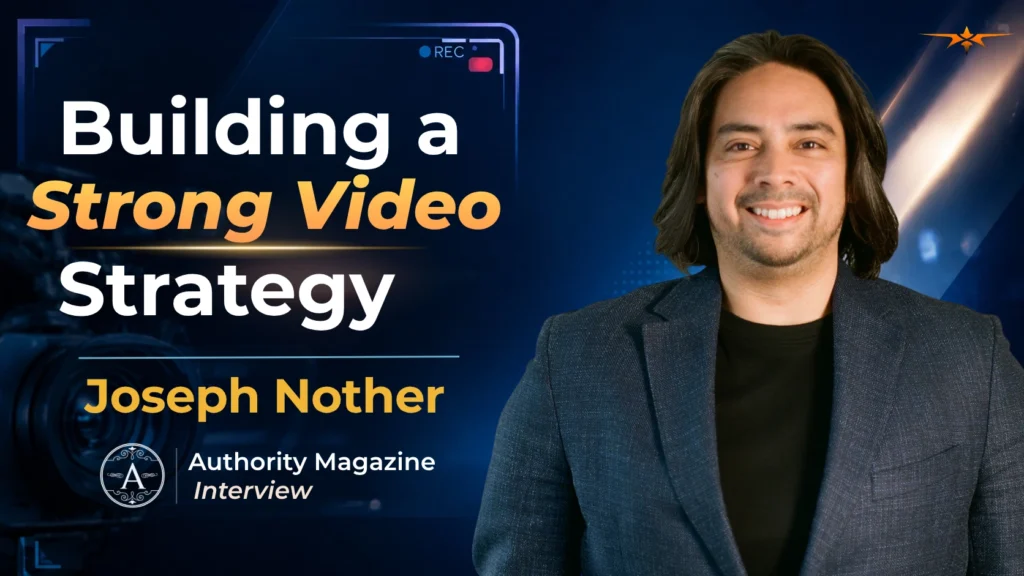
Joseph Nother on Building a Strong Video Strategy
A strong video strategy starts before the camera turns on. Brands need to know who they are speaking to, what story deserves attention, and what success should look like before choosing the format, crew, locations, or production budget.
Joseph Nother is Co-CEO of Designsensory and an award-winning creative with decades of experience across branding, advertising, marketing, and production. His Authority Magazine interview focuses directly on how brands can use video to communicate their point of view, build credibility, and create content audiences actually want to consume.
For Beverly Boy Productions, that makes Nother’s framework especially practical. Video strategy determines what should be filmed, who should appear on camera, how polished the production needs to be, what additional assets should be captured, and how the client should judge whether the finished work succeeded.
Start With the Audience
Nother’s first principle is to get close to the audience. He describes creating a conference video with references written specifically for the people in that room, even though those same lines would mean little to an outside audience.
For Beverly Boy, audience definition can shape the production brief before creative development begins. A video for employees may need different interview questions, examples, pacing, and supporting visuals than a customer-facing brand film, even when both come from the same organization.
That clarity also helps the crew know what deserves coverage. When the intended viewer is defined early, Beverly Boy can plan interviews, B-roll, locations, and edit priorities around what will matter most to that audience.
Find the Stories Only the Client Can Tell
Nother argues that brands should identify stories and themes that genuinely belong to them rather than relying on generic industry messaging. Designsensory has applied that thinking internally by revisiting its history, visual identity, and recurring cultural themes as foundations for future content.
That gives Beverly Boy a stronger starting point for story development. Instead of building an interview around broad claims like quality, innovation, or customer service, production can look for specific founders, employees, customers, milestones, projects, or turning points that demonstrate those ideas.
Those details also give the crew something concrete to film. A distinctive story can influence the location, supporting footage, archival material, interview subjects, and visual structure of the finished piece.
Match Production Value to the Purpose
Nother emphasizes that brands can make poor production decisions when they have not clearly defined who the video is for, what it needs to communicate, and how its success will be measured. He distinguishes between candid creator-style content and projects that require stronger lighting, audio, and a more deliberate production approach.
For Beverly Boy, this is where strategy becomes a production plan. A national brand film may justify multiple cameras, controlled lighting, larger crews, location work, and detailed post-production, while a recurring executive series may benefit from a simpler setup that can be reproduced efficiently.
The goal is not to make every project look equally expensive. It is to invest production resources where they make the biggest difference to the story and its intended use.
Put Credible People in Front of the Camera
Nother says trust becomes more tangible when audiences see real people behind the brand, including founders, leadership, and frontline employees. He argues that audiences increasingly want something more human and relatable than an abstract corporate identity.
For Beverly Boy, selecting the right interview subject can be as important as selecting the right visual style. A CEO may carry authority for a strategic message, an employee may be more credible when discussing culture, and a customer may provide stronger proof when the objective is to demonstrate an outcome.
Production can then support that person with the right interview structure, lighting, sound, framing, and direction. The technical work should make the speaker easier to trust and understand rather than becoming the focus itself.
Define Success Before Production
Nother cautions against treating views and other surface-level metrics as the default measure of success. Reach, engagement, conversion, brand perception, PR impact, and audience response can all matter, but they represent different objectives.
For Beverly Boy, defining the objective early can change the entire production. A recruitment video may need strong employee voices and workplace coverage, while a product-focused campaign may require demonstrations, tighter calls to action, and several short edits for distribution.
Knowing the goal also helps clients evaluate the finished project more fairly. A video designed to strengthen brand familiarity should not automatically be judged by the same metric as a direct-response advertisement.
Plan the Shoot Around More Than One Deliverable
Nother recommends starting with a broader content strategy and then determining which ideas are best expressed through video. His framework considers what the brand should create, co-create, curate, or commission based on where its authority and strongest stories exist.
For Beverly Boy, that broader view can make a production day work harder. If the client knows in advance that it needs a main brand film, executive clips, recruiting content, vertical edits, and additional interview material, the crew can plan those needs into the shoot instead of trying to manufacture them afterward.
That may affect camera orientation, interview questions, B-roll coverage, framing, talent scheduling, and the amount of material captured. Strategy therefore becomes part of production efficiency, not just marketing planning.
Help Speakers Find the Right On-Camera Approach
Nother acknowledges that people communicate differently in front of a camera. He prefers an unscripted approach after preparation, while others may need written material or a teleprompter, and he argues that each person needs to find the format that works for them.
That gives Beverly Boy several production options rather than forcing every subject into one interview style. Pre-interviews, conversational questions, teleprompter delivery, shorter takes, or guided talking points can all help the speaker communicate more naturally.
The objective is not to make everyone perform the same way. It is to create the conditions in which the person can deliver the message clearly and credibly on camera.
Team Beverly Boy’s Takeaway
Nother’s interview reinforces that video strategy should guide production decisions from the beginning. For Beverly Boy, the opportunity is to help clients connect audience, story, spokesperson, production level, deliverables, and measurement before the crew arrives on set.
That creates a clearer brief for production and a more useful final asset for the client. The camera is only one part of the process; the larger value comes from knowing what the camera needs to capture and why.
Conclusion
A strong video strategy gives production a purpose. When the audience, story, format, and desired outcome are clear, Beverly Boy can make more deliberate decisions about what to film, who to feature, how to produce it, and which assets the client will need afterward.
This article is based on an interview originally published by Authority Magazine. Read the full interview here.
