
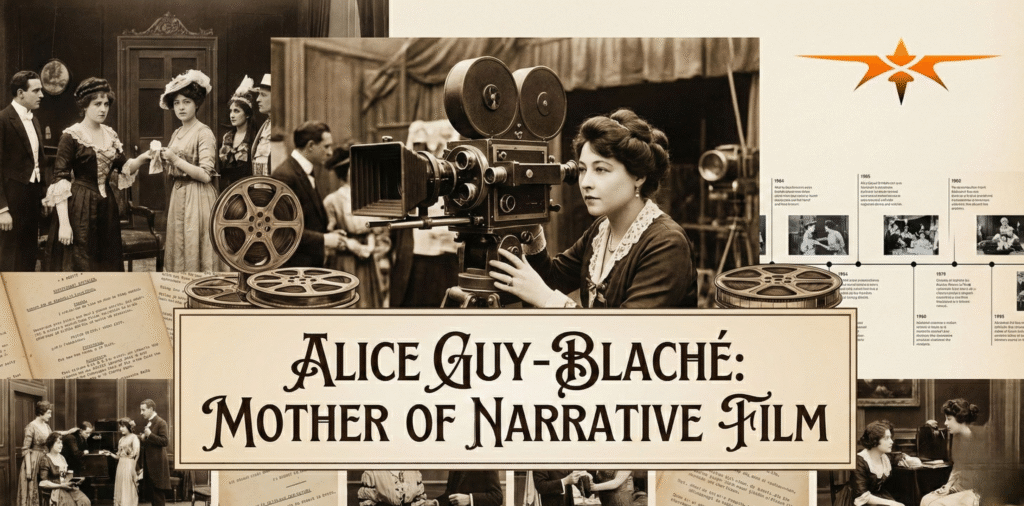
WHO WAS ALICE GUY-BLACHÉ AND WHY IS SHE IMPORTANT IN FILM HISTORY?
Alice Guy-Blaché’s remarkable journey began in Paris in 1873, where she grew up at a time when society strictly limited women’s roles. As a young woman, she seized an early opportunity by joining Gaumont, a pioneering motion picture studio. While working as a secretary, she discovered her passion for films and quickly began exploring the unique possibilities of moving pictures. You can see her early curiosity in the way she experimented with storytelling at a time when most films simply recorded brief, everyday scenes.
Her willingness to innovate set her apart from other early filmmakers, and she soon developed a distinctive narrative style. By focusing on characters and plot, she demonstrated cinema could do more than document moments—it could engage audiences through imagination and story.

As her reputation grew, Alice Guy-Blaché received permission to direct her own projects, which was highly unusual for a woman in the late 19th century. Her debut film, “La Fée aux Choux” (“The Cabbage Fairy”), made in 1896, is widely recognized as one of the first narrative films ever created. In this short feature, she utilized primitive special effects and editing techniques to bring a charming tale to life. These innovations were groundbreaking, and they revealed just how powerful films could be in telling original, engaging stories. Her early commitment to narrative form helped pave the way for the cinematic storytelling techniques we rely on today.
NARRATIVE PIONEERING: SHAPING EARLY CINEMA
During the formative years of the film industry, very few filmmakers were interested in complex stories. Alice Guy-Blaché’s intuitive grasp of storytelling marked her as a true visionary. She explored themes like fantasy, drama, and comedy long before these genres were defined in popular culture. By doing so, she invited audiences into new worlds, helped shape film language, and set impactful precedents that influenced other directors.
Her innovations included experimenting with early editing, theatrical mise-en-scène, and even primitive versions of synchronized sound. You can appreciate her courage when you realize that, despite working in a male-dominated space, she never hesitated to push creative boundaries. Guy-Blaché encouraged others to view cinema as a vehicle for stories, not just spectacle or technical curiosity.
In each of her projects, you see an emerging understanding of how visual storytelling differs from other forms of art. She often cast children and everyday people, bringing authenticity and relatability to her work. Her films frequently addressed social issues, showcasing her empathy and sensitivity as a director. The way she filmed simple human moments helped modern directors realize that meaning in cinema could be both subtle and profound. By trusting her instincts, Alice gave future filmmakers permission to experiment and evolve.

BUILDING SOLAX STUDIOS: A LANDMARK ACHIEVEMENT
In 1910, Alice Guy-Blaché made a bold move by establishing Solax Studios in the United States, becoming one of the first women ever to run an independent film studio. This was a significant moment for both women and the film industry in general. At Solax, she directed and produced hundreds of films, managing all aspects of production and business. Her leadership at Solax gave her unprecedented creative freedom and proved that women could excel not just behind the camera, but in positions of power.
Guy-Blaché remained committed to telling diverse stories and providing opportunities for women both in front of and behind the camera. She hired female crew members and fostered an inclusive work environment, which was exceptionally rare at the time. Through her work at Solax, she created space for new voices and perspectives, helping to challenge and reshape cultural expectations about gender in film. Her daring business decisions and creative resilience established new standards for what was possible in the early American film industry.
Solax quickly gained a reputation for innovation under Guy-Blaché’s direction. She experimented with color tinting, synchronized sound technologies, and inventive camera techniques—approaches that would later become standard in Hollywood productions. Audiences responded to her imagination and willingness to try new things, and Solax thrived during its peak. Her films addressed contemporary issues, proving cinema’s potential as a force for social dialogue and cultural change. If you look at Solax’s catalog, you’ll discover a dynamic blend of originality and technical experimentation that inspired many of her peers.
INFLUENCE AND ENDURING LEGACY
Alice Guy-Blaché’s influence in film history reaches far beyond her era. She actively shaped the transition of cinema from novelty to art form by improving narrative structures, developing new filmic techniques, and promoting greater inclusion. Her work not only elevated early filmmaking standards but also broadened what stories could be told and who could tell them. For years, however, her achievements faded into obscurity as film history often credited her male contemporaries instead.

Recently, historians and scholars have worked tirelessly to recover her remarkable story, ensuring that future generations understand her true place in the cinematic pantheon. By shining a light on her legacy, you help correct the historical record and inspire young creators to recognize that anyone, regardless of gender, can shape the world of film. Celebrating Alice Guy-Blaché is not just about honoring a remarkable pioneer, but about building a more equitable and inclusive narrative for all of cinema.
- Directed “La Fée aux Choux,” widely considered the first narrative film.
- Pioneered experimental editing and special effects techniques.
- Founded Solax Studios—breaking ground as a female studio executive.
- Advanced early sound synchronization concepts.
- Advocated for women in filmmaking, employing diverse talents at her studio.
RECOGNIZING ALICE GUY-BLACHÉ TODAY
You cannot fully appreciate the history of cinema without acknowledging Alice Guy-Blaché’s vision and accomplishments. Her creative risk-taking and commitment to storytelling transformed how films are made and who gets to make them. Modern directors study her innovative techniques and recognize her role in shaping film language. By learning about her story, you gain a richer understanding of cinema’s origins. Alice Guy-Blaché’s name stands as a lasting symbol of progress, creativity, and inspiration for future filmmakers.
